When afraid…

“When I am afraid, I will put my trust in You.”  Psalm 56:3

I was driving the other day and thinking about some news that had taken me by surprise.  About halfway home, I found myself saying out loud, “God, I am afraid!”  It’s not the first time in my life that I have felt fear.  In fact, quite some time ago, God taught me that when we constantly think on or become consumed by our fears (or passions), we are actually forfeiting something better that God had intended for our lives at that very moment.

Once home, I just couldn’t shake the truth that had come from my lips.  For me, I take great comfort from being in God’s Word.  It is where I go when the world feels like it is spinning a bit too fast.  As I finished unloading the car, I grabbed my Bible and came across my new journal.  There, right on the cover, sat Psalm 56:3 in beautiful lettering:  “When I am afraid, I will put my trust in You.”  How about that!?!  Right there, in large words, was exactly what I needed to see.  It was being afraid that I was truly grappling with.  So with pen, journal, Bible and phone in hand (my instant dictionary), I sat down to explore this verse some more. It’s almost always a good bet to start with the word that is sticking out to you.

“Afraid” is “feeling fear; filled with apprehension; feeling regret, unhappiness or the like; feeling reluctance, unwillingness, distaste, or the like.”  Dictionary.com/afraid.

Synonyms (just some of them): “anxious, nervous, shocked, suspicious, alarmed, aroused, discouraged, disheartened, dismayed, frozen, in awe, intimidated, spooked, perplexed, stunned, upset, worried, sorry, hesitant, backward, uneager…”  Id.

What also struck me about Psalm 56:3 was the active words that required both my awareness and my effort in response to the feeling of fear.  In this verse, the psalmist highlighted our need to both acknowledge and understand what we are feeling.  But why?  Because by understanding when we are afraid (and all the components of its definition…like regret or unwillingness…who knew those were indicators of fear?), we can implement the next step of Scripture to settle and calm ourselves.  To return our internal thoughts to a state where fear–and its friends: regret, unhappiness, reluctance, unwillingness–do not control our time, decisions or worlds.  A state where we are not running down roads of infinite worse-case scenarios that God never intended for us to venture.  You know, the ones that are unlikely to happen anyway.  So what do we do to take better control over what we are feeling?

“…I will put my trust in You.” (Psalm 56:3, emphasis mine).  Ah, part of the problem lies in recognizing when you are focused on God and when you are not.  When we take the time to acknowledge our feelings, then we can–and its our responsibility deemed from the words “will” and “put”–actively seek to turn our trust back to God rather than staying captive to one of the many synonyms of “afraid”.  When we allow our fear, or feelings of fear, to take over us, we are setting that which is making us afraid above God.  We are not trusting Him with each of our moments that He already knows we are going through.

Each of us, every one of us, will have moments where fear is a part of our lives; let us pray for each other that we will choose to trust more in God.  It is one of the strongest themes you will find, cover to cover in your Bible, and it is well worth living out.

“‘Do not be afraid, you who are highly esteemed,’ he said. ‘Peace!  Be strong now; be strong.'”  Daniel 10:18-19


Arise

You might wonder how it was that I could envision Joshua sitting on a wind-swept sand dune grappling with his fears?

A simple word in the Scripture, the English Standard Version of the Bible.

“Moses My servant is dead.  Now therefore arise…” Joshua 1:2 (emphasis mine).

It is easy enough to miss.  To gloss over and pass by its significance.  We can rush to what offers balm to our soul, words like, “Be strong and courageous”. You know the ones that can give us a temporary shot in the arm to boost our morale.  But have you ever stopped long enough to consider just how Joshua was able to find the strength and courage he needed to go somewhere that held so much unknown and uncertainty?

Or how that father found the strength and courage to walk past his fellow neighbors and local synagogue leaders and fall at Jesus’ feet begging for His divine intervention in his daughter’s life?  A man heralded as a ruler of his local town on bended knee pleading for help from Someone Who was virtually a stranger.

Have you stopped to ponder the profound implications behind the movement they both had to make in order to fulfill their destinies that are written in a book that has survived longer than most written documents?  So many classic stories contain messages of supernatural strength and compelling courage that no mere mortal could produce, but is that the case here?  I am not so sure that it is.  It seems to me that God doesn’t like pedestals in our world, for when we use them, we often begin worshiping something that was never meant to be worshiped.

Rather than moving quickly past Joshua and Jairus’ stories, let us dig in just a little bit more and look at the word, arise.

“To get up from a lying, sitting or kneeling position, rise; to awaken, wake up; to move upward, mount, ascend; to come into being, action or notice, originate, appear, spring up; to result or proceed, spring or issue.”  www.dictionary.com/arise

Whether Joshua was sitting or kneeling, his heart was in a position lower than God wanted it to be.  God’s first instruction to him, to help him where he was, was to implore him to move from the position he was in.  And that makes sense.

Many times in life, whether it is physical, emotional or spiritual, we become stuck.  What is only a season feels like an eternity.  We may know that we are moving through a tunnel, but lose sight of that knowledge when we begin to wonder whether the light at the end will ever appear. Grief, in particular, is a long winding road where darkness descends and light battles fiercely to penetrate.  A day can be glorious and filled with abundant sunshine of radiating love, and the soul burdened by such loss can barely feel the warmth of those rays.

Joshua’s love and trust for Moses and God are mapped out before us in the books that exist before the book of Joshua.  No matter how strong he was, nor how courageous he had been, Joshua’s heart had likely sunk to new depths of pain that only the death of a loved one can bring.

It is interesting to me the paradox that often comes with faith. We want to be comfortable, able to see clearly the path before us as well as the end result before we become willing to move from where we are, but true faith doesn’t allow it.  So many times, some foreword movement, that emphasizes trust, is required before such clarity is gained.  And that is exactly how God began His words to Joshua.

He told him that He understood the crux of his paralysis:  Moses was dead.  And then, in what seems a bit surprising, He told Joshua to get up.  Staying there, motionless, in that pain would not move him towards the place God had prepared for him.  Remaining in that desert would not bring Moses back, nor would Moses have wanted him to continue in the same sandy wasteland that they had been sojourning through for so long.

If we go one step further and look at their journey in the desert, we will find that even in the midst of their sin and disobedience, God continually called on them to move. To arise from those moments and places of transgression and venture forward, even when they were really going nowhere because of their persistent state of sin.  Maybe that was Joshua’s training ground for understanding that it was crucial for him to move when God asked him to move.

And the father, what can we draw from his story?  We know he had a home.  We know he had wealth, helpers and the concern of many.  Because we are told that he was a ruler, we can presume that he lived in a manner of comfort that afforded pleasures which could have soothed his aching soul. We are not told that he lived at the harbor. Instead, we are told that he ventured there and met Jesus as He got off the boat.

By implication, can we see that his efforts began when he arose from his situation and moved towards another potential?  Do you see that if he sat there and stayed where he was, his daughter wouldn’t have lived?  Can you visualize him leaving his comfortable chair, putting on his shoes and hurrying out the door in the desperate belief that any hope of life for her was tied to him taking one step after another in the only direction he could find?  Can you see the pain that he had to endure in leaving the side of his loved one in what was potentially the last moments of her life?  The risk of missing out on his last remaining chance of being together with her. Steps that grew heavier the further he went.

Further, when the news of her death spread through the crowd and reached him, can you comprehend how difficult it must have been not to crumple to the ground and give up his last remaining hope?  Instead, he was strengthened and given courage through five faith-testing words:

“Do not fear.  Only believe.”  Mark 5:36

If believing is the antidote to fear, then arising from our situations is the needle that delivers the antidote.  It is the movement that breaks the tension and delivers the strength and courage to continue on.

It starts when we come to understand that the wisdom we need to find the right direction out of where we are stuck will come when we put God above our fears.

“‘Behold, the fear of the Lord, that is wisdom, and to turn away from evil is understanding.'”  Job 28:28

“The fear of the Lord is the beginning of knowledge; fools despise wisdom and instruction.” Proverbs 1:7

“For the Lord gives wisdom; from His mouth comes knowledge and understanding; He stores up sound wisdom for the upright; He is a shield to those who walk in integrity, guarding the paths of justice and watching over the ways of His saints. Then you will understand righteousness and justice and equity, every good path; for wisdom will come into your heart, and knowledge will be pleasant to your soul; discretion will watch over you, understanding will guard you, delivering you from the way of evil…” Proverb 2:6-12

“Be not wise in your own eyes; fear the Lord, and turn from evil.  It will be healing to your flesh and refreshment to your bones.” Proverbs 3:7-8

Understand that when we choose to cling to our fears over God Who is continually nudging us to move out and away from them, we are fearing them more than Him. When we believe that we are stuck, that no light will shine again upon us, we are selling Him short. We embrace the evil message that He is not able nor willing when we choose to believe fear’s power over us rather than His. When we demand that our paths be well lit and life make full sense to us before we will trust Him enough to take that needed step, we are headed down the wrong path already and away from that which has the most potential to heal us. True faith doesn’t make such demands.

Instead, faith puts God in the right position above all else and trusts that when He asks us to “arise”, we should do so no matter how hopeless or uncertain our situation look…

“Taking her by the hand, He said to her, ‘Talitha cumi, which means, ‘Little girl, I say to you, arise.'”  Mark 5:36 (emphasis mine).


Finding strength in the face of fear

“Do not be afraid, only believe.” Mark 5:36

A desert.  A hot wind blowing.  Gripped with grief, sorrow and an aching love, a man sits on the edge of a wind swept dune looking out towards a land rich with promises. His heart throbbing with the pain of loss and the uncertainty of what lies ahead.

Behind him is a sea of tents.  A mass of people; men, women and children.  They followed a man out of the only land they had ever known in hopes of finding a better life for them and their children.  That man was now gone, passed on to the heavenly realm, before they were able to enter the land beyond the Jordan.

Looking back on those tents, this man wondered just how he could lead them.  He had been Moses’ assistant for some time, and while he had faith, leaving the desert they had known since he was a young child seemed frightening.  Commanding, guiding and moving all those lives to a land, beautiful and unknown, would be no easy task.

As the wind blew across his face, doubt began to creep in.  How could he finish the task being that his great mentor could not?

A father and wealthy ruler, desperately moving through a crowd, searching. A young daughter writhing in pain and sickness in the upper chambers of their home. The house full of those who, by the day’s standard, were best suited for caring for her.  A clock ticking for not one had been able to stop the advancing deterioration of her body.

The crowd was large and wide as they waited at the harbor for a boat carrying someone they had heard of.  The excitement of His arrival pulsated through those huddled near, though they did not fully understand just who He was or what He was capable of.  A gentle, salty breeze blew through air.  The noise of the crowd and busyness of the store fronts that aligned the harbor filled the space with constant hum.  The master of the ship, the healer of the sick, stepped out onto the shore as the crowd gathered around Him.

There, the ruler, the young girl’s father, pushed himself through to front and fell on his knees, humbly pleading for his daughter’s life.  The father filled with fear at the prospect of loosing his beloved implored:

“My little daughter is at the point of death.  Come and lay Your hands on her, so that she may be made well and live.”  Mark 5:23

These moments in Joshua and Jairus’ lives give us something to ponder. A glimpse at how to find strength when we feel at our weakest, overwhelmed by fear.

The book of Joshua starts with God telling Joshua to “arise”, there was still a job for him to do despite the grief that he felt.  The time had come to move forward, and yet, God knew this new transition into Moses’ leadership role would bring about new and unsettling fears in Joshua. You see, Joshua had been filled with strength and courage long before this moment. He had displayed it since he was young. In and through Moses’ mentoring, Joshua had found and learned what it meant to face fear.

But sitting on that sand dune, alone, at the helm of the caravan filled with hearts aching and longing for a permanent home, Joshua likely felt more fear than he had ever known. There was no mortal man above him to take the fall if a wrong decision was made. No one to make the final decisions anymore. The responsibility rested on his shoulders, alone, when Moses laid hands on him before he passed on. There was no other hand to guide the staff and to discipline the people, and oh, how he had watched them love to complain. Those matters now fell solely upon him.

God, being near him, sensed the dread that had fallen upon him.  He saw the fear beginning to spiral out of control within Joshua’s grief-stricken heart as he looked over the river Jordan to the land Moses had been leading them towards.  Images in his mind of the large masses of people, animals and supplies having to fight to cross a river to head into a land where enemies would be waiting. Battles looming at his charge. Lives impacted and changed forever.

And driven across the warm, sand covered plains, these words came to him:

“Just as I was with Moses, so I will be with you.  I will not leave you or forsake you.  Be strong and courageous; for you shall cause this people to inherit the land that I swore to their fathers to give them.”  Joshua 1:5-6

While we can think of strong as being physical capable of exerting force, it is also very much applicable to what is going on in your mind.  It is to be “mentally powerful or vigorous; especially able, competent, or powerful in a specific field; of great moral power, firmness or courage.”  www.dictionary.com/strength. It can involve being powerful in influence and authority as well as having the resources necessary to affect that power. Id. Yes, it can result in being aggressive and willful, but it also involves being clear, firm, solid, stable, thriving, and well-supplied. Id. Most who are strong develop the ability to resist attack as well as the ability to withstand strain, force or the wearing that occurs from the pressures of everyday life.

In some cases, to be strong may have little to do with physical fortitude and everything to do with what you believe in your mind.

As Jairus and Jesus made their way towards his home, you must understand that he was feeling an incredible amount of pressure to get there as quickly as possible.  His very words to Jesus conveyed just how sick his little girl was.  You can almost feel the dread rise as they slowly move through the crowd, only to have Jesus stop to address a woman, who was also desperate for healing.  The words that must have been running through that father’s head, “We don’t have time for this!  Please, please press on. My daughter is dying, and this woman is at least able to stand, walk and talk.  We must go. Come on!  Come on!  We’ve got to go!”

And if he thought he was filled with fear and dread at that moment, then came the startling news in the crowd.  The words rising above the rest, “Your daughter is dead.  Why trouble the Teacher any further?”  Can you imagine what overcame him in his mind? The fear no longer a little ways away, but instead, front and center: your daughter is dead and there is nothing you can do about it.  Oh, the crippling pain.  The breaking of a heart…

Yet these words were spoken to him by our ever loving God:

“Do not fear, only believe.”  Mark 5:36

I am not a fan of the idea that we can “will” life to happen by positive thoughts and considering only that which makes us happy.  The idea that we can mentally “will” the steps of our lives where we want it to go isn’t supported in God’s word.  Repeatedly we are told that it is God who orders our steps and that life contains not only good but hardship, pain and suffering.

“Will” becomes a part of the picture through the choices we make in this life as each opportunity for choice arrives.  We can’t “will” those opportunities, but as they present themselves, we will have a choice to make in regards to them. Consequently, understand that Moses never entered the promised land. Why? Because, near the end of his life, he disobeyed God. He made a wrong choice, even though he wanted to enter the promised land. We will all have moments that we can’t will or pray or get ourselves out of. Had that been the answer, Jairus would never have needed Jesus. His daughter would have already been better.

Yet, those words, “do not fear, only believe,” are obviously meant to teach us something about the moments we cannot control.  The times when we are faced with great uncertainty.  The intersections where we can pay the toll and board the fear train that allows us to crumble to the ground.

But look again, it was in that moment–the very moment the fear was the biggest and almost crushing–that Jairus, though not understanding how it could be different than what he was just told, was instructed to turn away from fear.  The antidote Jesus handed to him to fight his fear was  “Only believe.”  

Strength arises when we are willing to believe that we are not alone in our struggles. God told Joshua, “Just as I was with Moses, I will be with you.”  Jesus reminded Jairus that He had agreed to go with him to make his daughter well.

It’s not the size of your enemies that matters.  It is not the vastness of the open land ahead of you; the unknown of what lies unseen.  It is not the crowd of naysayers pressing against you.  It is not the swell of tents, the obstruction of buildings, nor the multitude of highways laying within your vision that prevents you from moving forward.

It is fear.

It is when we let fear begin to rise and build within. When it goes from hardly being a blip on our radar to overwhelming because of the circumstances before us.  It saps our strength as it grows.  It consumes our peace and confidence so that it might disarm and paralyze us right where we are.

But remember, the best form of strength comes in believing from within.  And where did Joshua find the strength to arise and prepare the people to embark on moving forward? By trusting and believing his journey was not one traversed alone bearing the weight of all that was before and behind him. No, he came to believe and trust that God was good to His word and would be with him each step that he took.

And Jairus?  He saw the compassion of our Savior and found the internal strength to believe there was a reason for him to continue on to his household.  He didn’t call off the journey as the others had asked.  He didn’t relieve Jesus from going.  He followed Him, choosing to believe that fear–the very real fear that he felt–wasn’t in control.

Neither of their situations were easy. Fear works best when our situations are hard. It will fight to control when you least want it to. It doesn’t come when you are strong; it preys on you when you feel weak. Sitting on a hillside grieving the loss of a loved one and feeling uncertain about the future. It will lurk when you have done all you can do and have no further control to stop loss from happening.

You won’t find the antidote in the weight room of a gym or in a self-help book of library; you may learn or gain tidbits towards strength, but they will only be components.  Why? Because much of the strength that will propel you forward in life lies in your mind.

To strengthen your mind and your thoughts comes from believing. The belief that with God, all things are possible. The thought processes of your mind that believe you are more than able, and where you are not, He is.  It is the understanding that what lies within you is more powerful in changing your world and opening up doors to new opportunities than any obstacle set in your path. Your success lies not in “willing” things to happen, but in moving forward with the belief that, with hard work and right living, you will reach your goals and destination.

Strength to overcome fear arises through believing…

“Taking her by the hand He said to her, ‘Talitha cumi,’ which means, ‘Little girl, I say to you, arise.’  And immediately the girl got up and began walking (for she was twelve years of age), and they were immediately overcome with amazement.”  Mark 5:41-42

Being willing to learn

“But they made light and went their ways, one to his own farm, another to his business.” Matthew 22:5

Each Easter season, I pray asking God to give me ears to hear and eyes to see and a mind to comprehend just what it is He needs me to see. Much of the time, I am listening for stories and themes.  Watchful to see how things can be done better.  Processing later what seemed to have stuck out to me during my day.  Sometimes, just sometimes, those moments really hit home a lesson…

No automatic alt text available.

We have a system in place for how we build baskets.  It runs rather efficiently.  Because we pray asking God to bring whatever it is that we need, things come in all different shapes and sizes.  That can be both good and bad.  In the realms of baskets and stuffed animals, bigger is not always better, though it enticingly looks that way to most.  And lately, we have had an abundance of big baskets.  Ones that are slightly bigger than the average size Easter basket.

I learned many seasons ago to put away the large ones. When kids come to build, they become fixated on wanting to build the “biggest” ones. They are sure it will be super cool! What I found is that they would go to the shelves and look for all the normal things that go in a regular size basket. The next thing I would see is a puzzled face standing before me, with shadows of disappointment cast upon it, as they weakly would ask, “Can I get candy…?…?”

The problem would be that in their rush to build this awesome sized basket, they had missed the spatial concept that regular sized items don’t fit well in a very large area. In fact, all the goodies tend to float around with lots of space that the builders are trained to not allow. Unsure of what to do, they stand there befuddled and we, then, have to take apart the basket and find bigger items to fill it. It is a little more labor intensive and thought provoking on their end and mine. So I often tuck those baskets out of sight until a seasoned builder comes; one who knows how to handle bigger better.  The temptation, taught in our world, that bigger is better, is more than most kids can bear to steer clear from. Hence, “out of sight, out of mind” works well in removing this cog in the system.

Image may contain: 1 personBut this season has been slightly different than most and because of more gentle stream of baskets arriving, I have had the “bigger” ones out to use.  Now, by the basket table is a sign that tells of our “Big Basket Rule”:  big baskets require big stuff…big stuffed animals, big books, and any big toys.  They get the same amount of stuff as the other baskets, but the contents have to be in proportion to the basket.  Now many struggle with personal interpretations of what “big” means, so we have them ask before using a bigger basket. When they do, I tell them that they have to gather all their items first. Once I see what they have, we then pick out the basket that best fits the components. From there, the basket is assembled and off to the wrapper.

Yesterday, there was an abundance of big baskets for a normal session.  I tucked them up against the wall and on our basket grassing station (where the empty baskets await Easter grass).  I put lots of normal sized baskets out at the front, but the temptation was too great for many.  What is normally a one-time occurrence during an occasional build became a re-occurring theme throughout both builds.  And I must admit by the last building time, with aching feet and fading eyes, I was growing tired of seeing those large baskets and repeating the mantra of “big baskets need big everything.”Image may contain: indoor

I’ve been writing a fair amount about Jonah 2:8 lately.  A verse that God has blessed my life with.  It goes something like this:  “Those who cling to worthless idols forfeit the grace that could be theirs.”  Early on in my exploration of the word idol, somehow I came across the idea–in the etymology–that worthless fears can become idols to us. Lately I have been looking at the idea of how we “cling” to these fears by digging deeper into the concept of complacency.

As I was trying to google a verse, I came across this definition for the “theme” of complacency at Biblegateway.com:

“A self-satisfied state of negligence or carelessness to one’s personal situation.”

Interestingly, it suggested looking deeper at themes like:  spiritual blindness, idleness, sluggard, carelessness, indifference, apostasy, neglect, pride and self-righteousness. All of these things having or supporting some connection to the development of complacency in our lives.

It doesn’t take much to become careless in how one sees things in life.  In fact, we can become neglectful quite easily. Things like indifference can lead to us dismissing consequences too readily for what we say and do or what we choose not to say or do. Idleness and lazy supporting choices can make us sluggish to react to needs or wants in ourselves and others. And those things can lead to a disregard of what is important in life–to us and to those around us. We say we believe in God’s ways, and then we, through spiritual blindness, pretend not to understand what He is asking of us. That, in turn, can lead to apostasy when our choices abandon the very ways we claim we should be living. Moreover, because we want to stay where we are at, pride and self-righteousness lend aid to proving our decisions are best for all involved.

In Matthew 22:5, Jesus was telling a story about a kind father who held a great wedding feast for his son. He sent out invites to those He wanted to come. Back then, those invites went out well before the feast. They were kind of like today’s “save the date” notices. People responded that they would love to come, but when the second invitation went out, the people “made light and went their ways…” The Bible note to this verse, in the NKJV Life Application Study Bible version, stated that the people “were so preoccupied with the here and now that they had no concern for God’s kingdom.”

Complacency is so not our friend.  It leads us to being preoccupied with ourselves–our here and now–such that we avoid seeing the things that may need to change around us or in us; the opportunities to better this world and positively impact the way it operates. When we become self-satisfied, we become blind to the potential that exists to further His kingdom through how our very own lives touch the lives surrounding us.  And, my friend, that is indeed being neglectful and careless.  We live in this world, His kingdom. So do our children, our families, our neighbors, and so many others. Complacency says we do not need to worry about making this world a better place, so long as we are focused on ourselves and seemingly indifferent to the rest.

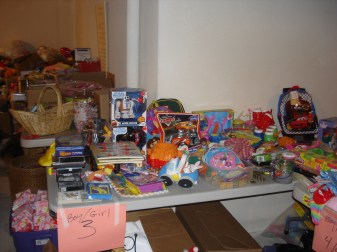
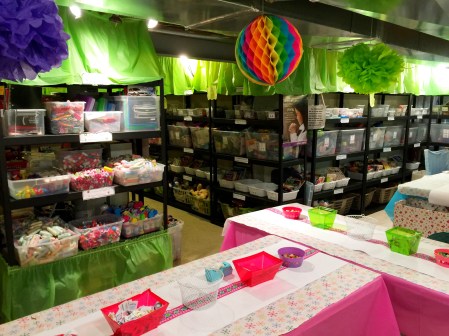
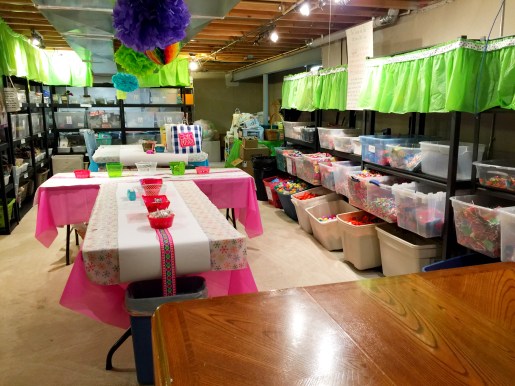
Birthday & Easter 2009 027When we first started building Easter baskets, we did so out of boxes. They were organized, but the boxes and tables were everywhere. We did so in a basement with just the basic lighting, a few bulbs on a string. It was a concrete floor; the bare necessities. As the outreach grew, God also grew our vision. When the day came, He showed us to reach up, which led to our current shelving system. The big boxes for overflow were relegated to the far corner and became a delight for the builders to occasionally dig through rather than a routine chore in building. Bins of books became lighter and more efficiently ordered by age and reading skill. Toys bins became clear and easier to see into, all categorized by gender and age. All the little things–the layers as I call them–found housing on our top shelves in clear shoe box containers so that they were accessible with ease.  A pattern began to flow that had not been there before.Image may contain: indoor

As we were filled with awe at what He was doing, we began to pray that God help us to stay away from pride and fear. That He open our eyes and ears for how things could be better–each time–as He had so faithfully been doing. To move our hearts and minds on how to better the system; that it wasn’t finished or done. We don’t want to settle into complacency that would hold us back from improving.  Over time, we have watched things unfurl and grow in ways that standing in that dim-lit, cold floor, box laden basement, so long ago, we could not see.

Understand, worthless fears are supported by complacency. Complacency, in turn, is supported by pride, self-righteousness, indifference, neglect, and so on. Every season, I hear someone ask if we are proud–“how proud we must be”–with this outreach.  And each time, I shudder inside. I don’t really have any reason to be proud. It is not I who moves the souls to make this happen. It is not me who knew best how to do this–remember, we started out in boxes and near darkness. It is not us who gently brings what we need when we need it. I don’t want pride in this, and surely, we don’t need to be bogged down with the weight of self-righteousness. For what we do is about growing faith, and there are no parts of indifference, carelessness, neglect, spiritual blindness, or the like, that inspire faith to increase in hearts where those painful things touch.

It is also why it is so fitting that my ears heard what they did last night, especially in light of Scripture He has had me digging into.  It took until this morning for my eyes to really understand why a particular basket had stuck out to me. A young lady had taken a larger basket without asking. As I was taking pictures of the baskets in the same area she was working, I noticed the large basket with smaller components.  I walked over and shared with her that she probably would need to find a bigger stuffed animal just to fill in the space.  She nodded her, in that tween way, that let me know she really didn’t want to hear that.  She wasn’t rude, but continued on her way. A little while later, I saw the same stuffed animals and realized it wasn’t going to change.No automatic alt text available.

Being a bit tired of the dilemma bigger baskets had been creating–things slow down, more need for intervention and redirection, others then want to build a “bigger” basket–I tried again to nudge her in the right direction. The direction of what usually works best for the baskets. I was met with same quiet indifference, but between my tiredness and a gentle nudge to see where it went, I let her continue on. Much to my humbling surprise, she was able to work in other larger components to balance out the smaller ones she had chosen. Her and I admired her work as I checked it before she got her candy.  I chuckled and said, “You can stick some in his mouth.  That would be so cute!”  With a big smile, she said, “That was my plan!”

The basket stuck with me all night, poking at me to appreciate better how well things can be done even when different from the rest.  How this work, God has us doing, has repeatedly called for a patiently balancing–and re-balancing–between being happy with the system and being willing and humble enough to allow change. Moments like these are what keeps my pride in check and my faith growing; it is why I pray for open eyes, listening ears, and wisdom to understand what is before me. Yes, there’s a great way to make bigger baskets, but it is not the only way. You never know, she might be the next inventor of something our world just can’t see yet, but may one day very much need.

As I scanned at the basket pictures from last night’s sessions, I stopped to look at hers. I knew it was a reminder not to become stuck in the smug satisfaction of this way, where we are right now with the way we build. A godly nudge to turn from complacency and allow forward movement even when it is not the easiest path before us. It was in that moment, of reflecting on the picture, when I found myself laughing at God’s exclamation point that I had not seen when approving her basket:

“Do not be wise in your own eyes; fear the Lord and shun evil.”  Proverbs 3:7

It is the verse she had chosen for her basket.  It sits tucked up in her coloring book, if you want to take a look. My friends, that is how bad complacency truly is. How evil it is for our thinking to be proud, self-righteous, smugly satisfied, or indifferent. Wisdom in our own eyes promotes believing in the fears that we feel are justified, worthless or not. The ones we choose to cling to through complacent living. Make no mistake, evil is not shunned there. It is grows quietly.  Grace is not realized there; it is forfeited.

How little worth our wisdom has when we fear something more than living out His ways. Let us pray that complacency does not find a resting spot in our lives. Let us be willing to move from the set ways of our earthly kingdoms and faithfully walk with Him on this journey through life. May we learn the better ways that He kindly puts before us…even if it is as simple as allowing an exception to the general rule of building bigger baskets.

“This is the way of the adultress woman: she eats and wipes her mouth, and says, ‘I have done no wickedness.'” Proverbs 30:20


What helps us cling to our fears?

The moment I finished writing the last post, I knew there was a word that I needed to explore more.  It felt like a tiny pin prick as I typed it into the list of antonyms for strong. Just the slightest nudge that there was something waiting to be fleshed out of that word.

For most of us, we have known this word personally.  A question often alerts us to its potential.  One that is asked when we face, or someone else does, difficult circumstances. The question begs, “Why is this happening?  Why are they (us) staying in that situation?”

Oftentimes, you will find answers like:  “It is not that bad.” “He doesn’t mean it.” “She probably didn’t even realize what she is doing.”  “I’ve learned how to deal with this and I am okay with it.”  “They can’t be without me!”  “I know the job and despite it’s problems, it is better than no job or an even worse one.”  All seemingly valid until the struggle returns to illuminate the soul, who deep down, is afraid to seek out change.

And really, we are no different than those we happen to see in such a situation.  How many times in our lives are we hampered by a fear, or fears, that keep us right where we are? We, too, employ the same excuses and justifications, hoping that no one goes deeper or asks harder questions.  If we can present “peace” and “acceptance” of where we are, then there is nothing more to explain, right?  But should we go deeper, all too often, those answers ring untrue…untrue to not only ourselves but those watching on the outside.

This is when it becomes important to meet fear’s sergeant in arms (I mean, good “friend”):  complacency.  It is the warm, fuzzy, safe friend of fear that carries enough gentle force to keep us relegated to our situation.  The justification that lulls the mind into endorsing and believing that change is a much worse option than the untruth that this difficult situation is best, or all, there will ever be. Complacency has this happy, contented appearance that things are peaceful–“It’s not that bad.  I am truly okay with it!”–despite the fact that there is something wrong with the picture.

Complacency is defined as “a feeling of quiet pleasure or security, often while unaware of some potential danger, defect or the like.”  http://www.dictionary.com/complacency (emphasis mine).  It is the soothing voice that draws you to look towards something other than the danger itself.  It cloaks itself in quiet pleasure or security, even though something harmful is moving closer. It is not an alarm system to prevent injury, but an antidote that makes things feel better even when they are not. It thrives on pleasure, despite the real and likely potential that pain will result. A pain that could be avoided, if only addressed.

You might wonder how complacency can cause us to become blind to the danger and defects that will hurt us.  Ah, its second definition:  “self-satisfaction or smug satisfaction with an existing situation, condition, etc…”  Change is hard, more times than not.  As a result, we intuitively gravitate towards what we think is the easiest route.  If we can convince ourselves that we are satisfied in these situations, then it becomes our job to be agreeable and pleasing to prove our satisfaction. Interestingly, satisfy means to “fulfill the desires, expectations, needs or demands of [another or ourselves]…to give assurance to or convince.” Id. Satisfaction causes us to focus on proving that there is no defect, no danger. It becomes our job to convince ourselves, and others, that we are more than satisfied with the status quo.

Smugness, smug satisfaction, enters the fray when maybe the situation is more difficult than we want to admit. Those difficulties may propel us towards a more rigorous defense. So we move towards believing we are specially and confidently equipped for this role. Worse yet, we may fool ourselves into believing that we have it better than most. This, again, prevents us from addressing the harm in our relationships and is how we become complacent. There is no reason for change when you believe you’ve got it all under control.  Life is as good as it gets when we describe it as a bed of roses, full of happiness, good times, and warmth, even when we know it is not true. When we pretend that it is all full of cheer, we have no need to worry about might be lurking in the shadows of life.

The interesting thing about complacency’s synonyms is how they evolve as you go through the list. It goes from cheer, satisfaction, smugness, contentment to creature comforts, enjoyment, gratification, peacefulness, restfulness to arrogance, egotism, narcissism, pride, self-importance, self-conceit, self-love, self-regard to snottiness, stuffiness, vanity, ease to anarchy, animalism, boldness, disorder, excess, forwardness, gluttony, immoderate, laxity, looseness to presumptuousness, self-indulgence, slackness and wantonness. That’s just to name a few.

Note there might be moments in life where being complacent actually results in peace, but in a situation where it is used to aid in not dealing with what is feared, it will not lead to greater peace. Remember it causes you to focus on the good parts of pleasure rather than the danger or defect that is also there. Moreover, as the need for diversion grows, complacency will lead to more gratification to prove you are happy, more pride to keep you from feeling less than, more boldness to get you what you need, more disorder to hide what isn’t allowed to be seen, more excess to bury the defects, more presumption to validate your motives, and even worse, more self-indulgence so the pleasurable life you are feigning holds some truth to merit staying put with what you fear.

What may start out rather innocent to avoid having to see something none of us like to see (danger or defect) can turn into a self-imposed blindness. If we can’t see it, there is no need to address the defect or danger that complacency helps to hide. Interestingly, going through the words associated with complacency–complaisant, complacent, compliant, and comply–a theme started to develop. They appear to revolve around the idea of pleasure and the fact that we should be pleasing and agreeable. It makes sense when you stop to think about it. If we focus on being agreeable or pleasing, much of the time that appeases the disagreeable and tucks the negative out of sight. Difficult situations and defects fade when we pretend there is nothing unpleasant occurring.

Going further, if you are disagreeable or unpleasing–or if someone is being that way to you–you are less likely to be “happy” or “satisfied” with the situation. Now being complacent isn’t so easy anymore. The more dissatisfied we are with something, the more likely we will want to move away from it, to change our circumstances. And that’s where complacency works well with fear. It allows us to buy in by proclaiming we are self-satisfied, even smug if necessary, so that we can avoid addressing our fears.  Rather, complacency allows us to draw them even closer in.

Further, do not the synonyms advance in such a way to show us how we can easily go from describing life inaccurately as “being a bed of roses”, to hide its deficiencies, to taking a more defensive stance of arrogance and snottiness that aids us in deflecting away the painful truth we want to hide? My friends, if we go back to the definition of complacency and deconstruct it, we will realize that it generally leads to a false sense of peace, an untruthful description of happiness, and is only convenient because it is hiding something more difficult to see.

Remember, complacency holds in its hands a distortion of reality because it lulls the person into ignoring a danger or defect. It does so by couching them to “accept” their situation as satisfying, to be gracious towards what is wrong by pretending it didn’t occur, and to act in accordance with the wrongdoer’s wishes, requests, demands, and requirements for that is what is best to keep disagreements at bay.  A temporary patch to a long term, continual, and likely-to-be repeated wrongness that has somehow become a part of our lives.

Complacency is built on hiding things that can harm us.  Thus it cannot be friends with truth because of what it hides. Truth does not hide pain and insecurity from our view. Truth, instead, strengthens our foundations so that we can endure what life brings rather than building for us a false reality that will crumble from hidden defects and dangers. Fears need complacency and pleasure, not the painful truth that their validity in our lives is of little worth.

As such, complacency just might be the arms by which we cling to our worthless fears…

The question then becomes where are we complacent in our lives, and how might that be holding us back from a truly better life that we are meant to be living?

“Because you have raged against Me and your complacency has come into My ears, I will put My hook in your nose and My bit in your mouth, and I will turn you back on the way by which you came.”  2 Kings 19:28


Friends of fear

“Be strong and courageous.  Do not be frightened, and do not be dismayed, for the Lord your God is with you wherever you go.”  Joshua 1:6

When we were contemplating having children, my husband and I already knew the name we wanted for a girl.  If we had a boy, there were three names that we liked.  Unable to narrow them down, we waited to decide until that fateful day God graced us with a baby boy.  His birth was a bit frightening and difficult, and even though I was not able to see him, I knew in my heart somehow his name was to be Joshua.  As they wheeled me out of surgery and towards a recovery room, my husband hurried to my side, returning for a brief moment, from where they had swept our little boy to.  He exclaimed, “Oh Michelle, he is so beautiful!  He reached up and grabbed hold of my finger.  I think his name should be Joshua.”  I smiled, as best as I could, and nodded in full agreement.

It was five years later as we visited a school that the principal asked our son’s name. “Joshua,” we said.  He laughed and looked at Josh and said, “You know that is a good name! Joshua, in the Bible, was a great leader.  You have big shoes to fill someday, young man!”

Joshua was one of the few young men who was brave enough to believe God and tell Moses that they could conquer a land full of those who seemed so much tougher and bigger than them.  It was only him and one other who found the courage and faith to trust that all things are possible when God is on your side.  It was Joshua, when Moses passed on, who became the leader of the Israelites.  The one who would take them into the land God had promised; the land Moses had only ever seen from a distance.

What I find so interesting in his story, Joshua’s, is that God repeatedly told him, “Be strong! Do not be afraid!”  In the beginning of it, this mantra is conveyed over and over again. Why? It appears that most of us were taught that Joshua was brave, or so it seemed.  But is that really a fair assertion?  That he was just automatically brave and unafraid. That he moved into this role, and into that land, without any fear whatsoever?

I don’t think so.  When God brings a message repeatedly, He does so for a reason.  He knows His servants will become afraid.  He understands that parts of life are scary and uncertain. He, Himself, has designed us to feel fear, especially in transitions and times that are unpredictable and unsettled.  Here the tribe of Israel was going through a monumental change, and Joshua knew all too well that he had “big shoes to fill”.  He also knew how darn stubborn the people, he was being asked to lead, could be.  He was headed into a land where change was going to be as abundant as anything else that lived there. And change, we, humans almost never accept easily.

So many times, when we are moving out of something we have grown comfortable with, our fears rise tall.  Our courage sinks low.  Our path becomes a bit unclear, and the noise in our heads and hearts sometimes fills us with dismay tempting us with disobedience and departure to an easier route in lieu of the seemingly difficult one ahead.  Joshua was no stranger to those temptations, or God wouldn’t have been repeatedly shoring him up with encouragement that he had strength available to him. He could find the courage. He could figure things out and not let dismay win the day.  All he had to remember was that God was with him wherever he went, that His word was available to him day and night to think on, and that careful observance and obedience would lead to success.

The other day I was in the Word and came across how important it is to be “strong”.  As I so often like to do I looked up the definition, but this time, what struck me were the antonyms.  God often asks us to be strong in whatever He is leading us towards, and knowing what that means is important.  But understanding where strength doesn’t lie is as equally important for it is in that wisdom where we will be able to rout out the easy untruths of what we perceive as strong enough and move towards becoming truly stronger.  Strong’s antonyms are:

feeble, infirm, unhealthy, unpowerful, weak;


agreeable, complacent, easy-going, irresolute, laid-back, uncaring, indistinct, mistakable, obscure, vague;


mild, moderate, delicate, low, pale, soft.  (www.dictionary.com/strong)

The interesting thing about “feeble” is that it is not just limited to physical frailness. We can be feeble when we lack moral resolve or even intellectual comprehension. Feebleness can result when something is lacking in loudness, brightness and distinction.  When it lacks force, strength or effectiveness in what is being attempted.

Now how can we apply that to our everyday lives?  Being feeble doesn’t mean it is the end of the story.  Sometimes adjustments can be made to give those weaker moments more strength, more loudness, more effectiveness, more brightness.  Hence, what God was doing for Joshua.  Giving him strength to face the challenges ahead with reassurances that what he would find what he needed if he just continued to persevere.

We live in an age where technology has put an overwhelming amount of knowledge literally in our hands.  If we are weak on a subject matter, we can dig in and see what we can learn.  From there, we hold the ability to hunt down the sources and verify their truth. We have a multitude of resources at our fingertips to help weigh the options and opinions. Further, we can enroll in courses at a local community college or even through our hometown venues, such as a library, that offer simple classes on subjects that increase our knowledge.  We are not meant to be trapped in mental feebleness; we just have to be willing to become stronger mentally when we can.

Most of the time, we are not truly stuck in feebleness of any kind. When our bodies shed the ability to function the way we want, or are accustom to, our minds can pray and think to the benefit of others as well as to ourselves.  All it requires is mental strength and courage to find an alternative to whatever it is that is holding us back in believing that we are too weak, infirm, unhealthy, or unpowerful.

Can you take a moment and see how faced with feeling weak, we may find our fear growing?  Can you understand how feebleness and fear become great friends?  When you feel weak, it is fear that tells you that you are not strong enough to overcome.  When you feel afraid, it is weakness that tells you that embracing your fear makes you safer and stronger.

Ah, can we hear the choruses, then, of agreeableness, complacency, and an easy-going, laid-back attitude singing praises to the power of your fear to keep you where you are? So many times, we act uncaring, irresolute and vague to hold at bay any commitment that might be being asked of us.  Being indistinct from the crowd lulls us into believing and embracing our fears as if they were a soft loving god beckoning us to stay willingly within their bonds.

We pursue mild and moderate so as to not aggravate what we dread, and thus, keep ourselves low in the need for strength and courage.  We may even think that life is so delicate, so pale and so soft that where God is calling us to makes no sense to travel towards.  Choosing, instead, to believe it is unnecessary in our limited wisdom, as we cling to what it takes to keep us where we are.

The antonyms of strong are truly some of the best friends any fear can find.  Most of them require no commitment, no exertion, no mental power or vigor the way that strength and courage does.  They don’t ask for influence for they are agreeable and easy-going.  They do not need resources or force to bring about good change because they are uncaring and irresolute about goals.  They don’t resist or rise up to challenge wrong because they are glad to be without power.  They don’t need to be strenuous or energetic to propel them in the right direction because they are okay with being complacent in health, life and relationships.  There is no intensity, no loudness, no bright light shining; fear, and its friends, are more than okay with us being pale and indistinct to the world that exists around us.  In fact, they thrive in the absence of strength and courage.

So know that fear loves the antonyms of strong.  Where it can flame their presence in your life, it will.  Fear knows such friends will only aid you staying resolutely where you are and not where God is leading.  And the more friends fear can find, the more power it will have over you.

Hence, why as Joshua transitioned into his new role and onto his new adventure, he needed to understand that strength and courage would be crucial–his greatest mental allies–in moving forward.  Embracing, holding, coddling, and clinging to his fear that he would not be able to lead like Moses, or that he would be unable to guide these people away from their liking for disobedience, would mean failure for sure.  God didn’t chasten him for feeling fear, rather He instructed him not to embrace it.  He presented him with an alternative:  “Be strong.”  Believe it. Know you are capable.  Trust that you have been designed with as much strength as you feel fear.  He didn’t say to Joshua, “I will make you strong.” Rather, He empowered him to be the opposite of what he was feeling, weak and unable.

Remove the fear that hampers you by disconnecting its friends in your life.  There you will find it weaken and with each step out of those trappings, you will discover new strength, courage and hope.  God is walking with you and will provide all that you need for the journey that lies ahead, as it is likely you, too, will also be called to step away from that which frightens you.

“Only be strong and courageous.”  Joshua 1:18


Embracing Trust

It’s coming upon a fun time of year around here!

img_2129

For the last few weeks, I’ve been working, with the help of many volunteers, on getting Families Building Faith’s Easter Basket Collection up and running.  Our basement houses the system we utilize to build baskets for children and families in need.  We started this outreach about 12 years ago, and it has built momentum–thanks be to God–ever since.

It is interesting how the mind works.  Many memories have accumulated over the years. The ones that seem to return and beckon for my attention are the ones solidified around loved ones who have gone home ahead of us.  In the beginning of putting away Christmas and digging out Easter, it was easy to stay focused on the tasks and to keep my thoughts busy.  But as the last bits of the system fell into place, my mind began to return to those who were once here but are now no longer.

img_2132

When I first started FBF, my parents weren’t sure what to think. As the years went by, and the Easter and Christmas outreaches grew, they both offered their support in variety of ways.  My mom liked to help with prepping for outreaches but my dad was more limited in what he could do. You see, he worked as a used car salesman.  His hours were long, and he didn’t have a lot of time to come when we had events.  His day didn’t end until late in the evening, which precluded him from much of what we did. Yet, given the chance, he would load his car with toys or baskets and transport them to varying agencies and food banks. And the more he saw, the more he’d tell others about what we were doing.

Then life changed.  He was diagnosed with esophageal cancer.  We all knew that wasn’t good.  Being in sales, my dad needed to continue to work, but much to our surprise, his application for disability was approved quickly.  In large part, because of the terminal nature of such a SONY DSCdiagnosis.  The government and medicine knew he had little time left.

Going from a life of long hours working to an early retirement of sorts seemed like the best scenario for his situation, but my dad was never one who liked to sit around.  Even on his occasional weekends off, he would putter around until the sun set.  He just enjoyed doing something useful whether gardening, mowing the lawn, socializing, doing household chores, bike riding, swimming, or canning vegetables; you name it.  The special thing was he could do it all with an incredibly genuine smile and joyful heart.

SONY DSCSince the beginning of FBF, I have longed for our family to be a part of what we do. And so, as Easter approached after his battle with cancer had begun, my wish was granted. My mom, who had long been helping, convinced my dad to come and see what he could do. Though still recovering from major surgery and treatment, he would make his way downstairs and do the tasks that we laid out. Sometimes it would be wrapping chalk. Other times, it would be sorting through things. All sorts of little tasks. After an hour or so, he’d return to the family room to rest and regain his strength, only to head back down to the basement once his energy had rebounded.

SONY DSCI remember, in those moments, being so incredibly grateful that he could finally see what was happening as he had only ever seen the end result–beautiful baskets.  Though his eyes were often tired, a slow twinkle reset in them.  As we prepared to launch into building, he was soon eager to be present. And indeed he was with me from start to finish that year, the only year he had left in his life here on earth. He became convinced God was doing something amazing–“miracles” as he would call them since he was around to see the donations coming in, the generosity of many, the kind hearts of those helping, and the inexplicable ways it all came together to produce something breathtaking.

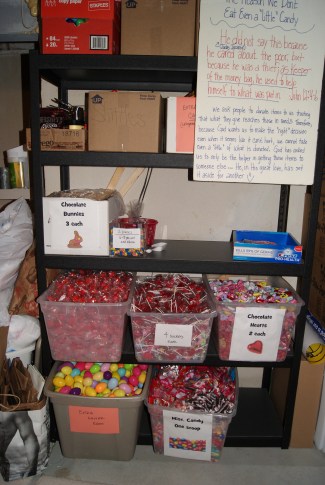
And so one day, as I was labeling the candy bins, he was standing near.  As I was struggling with trying to decide how many pieces of each kind of candy should go in the baskets, he said, “Michelle, they need more.

With a big grin, he smiled, “Kids love candy!!  That’s what I know!  You should put more in the baskets.”SONY DSC

He was right.  Kids do love candy.  Funny thing was I thought they were getting more than enough candy until he said that.  My initial thought was, “What?  They are fine!” But my hesitation to designate more had caught my attention.

It is an interesting thing to ponder the subtle effects of a quiet fear.  You see, I was afraid when I started FBF.  I knew God was leading me to do so, but I wasn’t sure I could do it.  I wasn’t sure anyone would want to be a part or would want to walk more closely with God and His ways on a more daily basis. I had no idea where or what it would lead to. And so, in those unknowns, I was keenly aware of feeling afraid. Yet, I could not bring myself to say no to what was being asked.

When I stepped out in faith–and past the fear–to start it, I knew we needed to reach out to help others in addition to being in His word and holding activities to grow fellowship.  And yet, again, there was trepidation in those steps.  Who could we help? How could we do so? Where would the help arise from when we were tapped out?  What were the ways to take?  Each step often being taken before the end results were ever in view, and believe me, sometimes there were long pauses and great trembling.  But as with before, I knew I couldn’t say “not I…not us.”  It just didn’t seem right to refuse under the misguided thoughts of “You, O God, don’t really need us to reach out to others, do You? You can move anyone, and You really must have meant that call to be for others.  You know the ones who You have given the fine gift of ‘serving’ to. ”  Yet, I knew that wasn’t true.  God was asking us to live His ways, which included helping others.

So, despite many years of building baskets, there I was on the floor taping number tags to the candy bins afraid…afraid to give more than what I could account for at that moment. Afraid of giving away too much. Somehow becoming governed by a quiet fear that wanted to underscore God would not bring enough. Really? The irony of my lack of faith and my father’s faithful encouragement beckoned for me to take a closer look at what I was feeling.

What was I truly embracing in those thoughts?  A fear that was telling me I would fall short; we would be lacking; someone would go without; there would not be enough?  Or, the God Who had been bringing more than enough for so long?  Was I really trusting Him with the potential that we could be even more generous than I had believed? Was I acting in faith by pushing myself to trust in God in that possibility, or was I instead staying put in the status quo so I could avoid having to stretch my faith yet again…

No automatic alt text available.Here we are at that stage again.  I’ve been placing the tags on the candy bins and waiting for the last few empty ones to fill.  Though a couple stand bare, I trust that the candy will rise in them. It’s been six years since I heard those words from my dad. He’s been gone five years now. And each time I walk by those shelves and have a moment to think, I hear him whisper:

“Trust Him and not fear.  Look and see if it might be holding you back in something?  Don’t let it.  Give more; trust more.  You know He is faithful; trust Him to meet you here.  You know He will.”

There was as an amazing freedom gained that day when my dad challenged me to find more faith.  To trust God that He could bring even more than I had dared to imagine. Now four shelving units full.  Grace and happiness continues each season as we watch those bins rise and fall and then rise again.  Trusting that what appears to be gone can be replenished.  Joy and delight displayed on the faces of the builders as they exclaim, “There’s so much candy in this basket!”  And faith being nurtured in the twinkling eyes of the children who rejoice at what they see their taste buds will delight in…

Greater grace abounding from giving freely rather than living in the fear of holding back.

A truth I try to search for and a question I challenge myself regularly with in growing my faith.  Am I embracing God or something else?  A lesson and memory I am forever grateful for.

“Those who cling to worthless idols forfeit the grace that could be theirs.”  Jonah 2:8

To cling

“Those that cling to worthless idols forfeit the grace that could be theirs.”  Jonah 2:8

Interestingly, if we look at how we are designed, fear is a necessary component of survival. It is something that starts early.  Though a young baby might not be able to fear all that an adult does, a loud noise can startle a baby into crying in a fit of fear.  An older person in the throws of dementia, who cannot speak, can still communicate being frightened manifested in trembling, turning away, avoidance behaviors, and even screaming and fighting.

We were made to sense and experience fear.  Hence, experiencing it does not automatically mean we are forfeiting grace.  No, it is not fear itself that is the problem.  It is when the fear is worthless.  When it has no real value other than to torment.  Or when it has surpassed its estimation and exploded into something it is not.

But there is something else that escalates the issue of worthless fears, and that is how we handle them.

Looking at Jonah 2:8, it would be wise to note that grace wasn’t forfeited just because a fear was experienced.  In fact, the mere experience of it might actually bring forward the gift of grace to strengthen and encourage in a time when life is, or should be because of the circumstances, frightening.

The hitch can lie in what we do with it.  You see, in Jonah 2:8, we are told “those who cling…”  Not just have.  Not merely experience.  Rather it is the clinging to worthless idols that develops into a problem for us.  To understand this better, let’s take a look at the definition of cling:

“To adhere closely; stick to; to hold tight, as by grasping or embracing; cleave; to be or remain close; to remain attached to; to cohere.”  www.dictionary.com

Digging into it a little more, let’s explore cohere:

“To stick together; be united; hold fast, as parts of the same mass; to be naturally or logically connected; to agree.”  Id.

So if we have a worthless fear, can you now see how devastating it becomes when we cling to that fear?  How we inhibit living a life that could be filled with grace at the sake of embracing and remaining connected to a fear that has no real value?  Note this as a picture, how can your arms be open to receiving grace when they are tightly wound around a fear that should not be in that space?

Can you further see how it gains more and more control leading to more and more grace being forfeited?  We pull these worthless fears closer and embrace them as if they are truth rather than falsehood. We stick tight to the restrictions those fears rehearse to us, sadly believing that they are the same mass as us–that they are a part of us, when they don’t have to be. Further, we try to logically connect more things to these fears in an attempt to increase their validity, and so that their influence only grows…while our faith in God, and His beautiful design of us, begins to shrink in their almighty shadows.

Too many of us are not only inhibited by fears that truly have little worth, but we allow our fears to remain close to us throughout the day.  We rarely leave them behind.  Worse yet, we accept them as if we have to be united to them rather than understanding it is a choice to choose them over grace, over God and His desires for us.  Might it be ourselves that hold fast to these fears, rather than loosening our grip on their influence, as most of us refer to our fears as if we have no other option?

While Jonah 2:8 beckons us to examine our fears and discern what ones have worth and what ones don’t, we also need to take a step back from them.   Note what ones you feel there is no hope of letting go, what ones seem justifiable despite an honest evaluation…as those, my friends, might just be the ones you are clinging to.  Here are some clues and justifications that can tip you off to the ones you might be latched on to (look for when you might be doing this towards a fear or a circumstance that gives rise to one):

clasp, cherish, continue, endure, freeze to, grip, hang in, hang onto, last, hug, linger, stay put, stick like glue; agree, associate, be devoted to, be tight with, be true…inseparability, intelligibility.

Note that your desire, to stick with your worthless fears, will go to great lengths to give you intelligent reasons for why withdrawing from those fears isn’t in your best interest. Clinging will occur when you insist on continuing with them, enduring their grip, freezing in the presence of a reminder of them, agreeing to their presence when it is not necessary, hanging on to the original reason that gave birth to them, be devoted to fighting for their existence by looking for any reason to support them being able to linger.

Because you will need to do the opposite to overcome your hold on them, it might be helpful to know about the antonyms to cling.  Let these antonyms inspire you to loosen your grip:

detach, let go, unfasten, divide, separate, disagreement, incoherence, incongruity, nonsense, unintelligibility

Understand that becoming unfastened or detached from these worthless fears is a necessary step in finding the fullness of God’s grace.  That may mean you have to let go of controlling your surroundings to prevent what you fear, and that may mean allowing more risk to exist.  It may give rise to disagreement within yourself as fear doesn’t usually like to dwell with peace and truth; it needs you to feel insecure about something.  Know that your steps and action plans might not be as harmonious as you would like.  You may even find things to be inconsistent or out of place.  Some of it may seem like nonsense; may even be unintelligible to what you have always known or what others have always known from you.

I often tell this story to those who now visit our home.  In our first house, everything had a place and it was very tidy.  When we moved to our second home, I kept up the same routine but had more house to clean and bigger dust piles that took a lot more time.  In fact, in kindergarten, when asked what his mom did, my son said, “Clean.”

As I began to walk more closely with God, I felt a gentle nudge to let go of that rigidity. While order and cleanliness have a valid place in life, my routine was more personally motivated than that and directly tied to an inward fear that I had long embraced. Over the years, I have come to accept a much less rigid standard resulting in more internal peace and more time with those I love.  In fact, I don’t chase the dust bunnies quite the way I used to.  I often wait for them to become dust bears.  Consequently I am not afraid, though I don’t necessarily like, when others see them peeking out from under our benches or tables.

Moreover, as this change began in me and I learned to let go of the fear I was clinging to, I found those driven by it in their own worlds scratching their heads and not understanding. It just didn’t make sense to them, and I learned to be okay with that.  It was when I unfastened myself from that fear and those rigid standards that I began to experience a new grace I had not known.  Dare I say, so did others in our household.

Yes, it will be hard work but finding the grace that is meant for you will only come when you stop clinging to those worthless fears you hold so tight.

Trust me, you can do it…

“In that day the remnant of Israel, the survivors of the house of Jacob, will no longer rely on him who struck them down but will truly rely on the Lord, the Holy One of Israel.”  Isaiah 10:20


It’s the little things that trip you up

While working with the aged, I have learned a couple of valuable lessons.  One, in particular, has become crucial in order for someone to remain in their home as long as possible without the need for additional supervision and care.

Believe or not, it’s rather simple in elongating their stay:  Get rid of the rugs!

Now most know not to climb a ladder as they grow older and more frail.  Many are very careful with the stairs.  Icy days are stay-at-home days for fear that a good fall will come with a trip outdoors.  But sometimes, the things that seem like they wouldn’t impact us at all actually become the biggest hazard to our safe passage in life.

What I’ve watched over time is that, as we age, our muscles decline.  It’s rather gradual, but suddenly lifting the bag of flour isn’t quite as easy as it used to be.  Neither is climbing up a regular set of stairs.  A full jug of milk can quickly become problematic.  The legs and arms wobble a little bit as we lift our muscles often making the body unsteady.  It is interesting because something as small as a two inch difference in the height of a step can make or break whether someone is able to enter an abode.

And the same is true for rugs.  You see, because lifting becomes more tedious as we age, we tend to drag our feet more.  We lift our legs less higher.  As a result, rugs become a nightmare waiting to happen.  The foot drags, catches the floor rug, the combination throws the body off balance, and down we fall.

Crash.  Break.  Sprain.  Ache.  Ouch!  “What happened?  How did it happen?  That rug that has always been there catching the dirt just caught me!?!  I never would have thought!”

Something so small.  Something lying flat and readily safe to most becomes one of the biggest risks to those struggling with their balance or lifting their feet.

Those things that catch water and dampness in a bathroom.  Those precautions that keep us from sliding across tile floors.  Those entry ways that catch the remnants from the outdoors before they track all over inside.  A great use in the right setting with those able; but disabling to those who have no room to spare.

The interesting thing is that fears are similar in a way.  We often seeing the big ones and are able to avoid them.  We don’t run in the street for fear of being hit by a car.  We watch for holes in a field when hiking through uncharted territory.  We avoid the big growling dog because he is readily visible to us as we walk by.

And so it is with our big fears.  You know what they involve and you know how to avoid them.  You likely have no problem identifying them and telling others that they exist.  You know your biggest fears–as both a friend and a foe–but what about your little ones?

You know the ones that can begin to cause the same apprehension in you but you shoo away.  The small nudges that change your cause and direction without you even thinking about it.  The pauses, the slight shiver, the hesitations, the quiet shrug, the drooped shoulders, the avoidance of eye contact–the little ones.  Are you aware of what it is that you are afraid of even though it is not screaming for your attention like your big fears do?

For as long as I can remember, I have been afraid of heights. I will tell you that straight up. Because of that fear, I generally try to keep my feet on the ground when possible.  I am fully aware of my fear and how it impacts me.  Over the years, I have worked to stop it from controlling where I go in life, especially in situations where the fear is loud and scary yet likely untrue.  Seeing New York City from the Empire State building was a perspective I would never have gotten from the ground.  Looking over Seattle’s harbor from the Space Needle was breathtakingly beautiful and worth every moment my heart pounded.

But lately, I have become more aware of the power behind “little” fears.  The ones that can be so easily dismissed; the ones you hardly notice.  The quiet fear of rejection, in most cases, does not keep someone from venturing out and among others.  While you can experience enough to keep it hidden, the fear encourages you to build strong walls and keep a safe distance.  The fear of failure cannot rule most in a way that is overtly noticeable because life is a series of beginnings and endings that happen every day despite the risk of not succeeding.  And yet, it might keep you from attempting “bigger and better” opportunities.  The fear of not being enough may be what is gently guiding you into pleasing others at all costs to yourself.

In a way, little fears are like the little floor rugs of life.  They, oftentimes, are borne of necessity in a moment to capture or prevent something from mucking up life.  But as we move on from there, and life progresses, these fears may become a hazard that trips us up unnecessarily.  Understand, the risk is unnecessary since it is the fear that is now the cause of our harm.  Just as removing rugs increases the safety in a home of those who are aged, rooting out small fears (that have been in our lives too long) increases the odds of us living life to its very fullest.

What if that little fear of rejection keeps you from the full enjoyment of truer, deeper relationships that life is now meant to bear?  What if there is something new waiting to be tried, and what if being successful is not really a part of the picture anymore?  Moreover, what if others actually applauded your attempt rather than only your accomplishment–the fear wouldn’t even be necessary!  What if you are already more than enough and truly need to know it?

In Jonah 2:8, God did not specify whether the size of your fear matters when He pointed out they were worthless.  Honestly, I believe He knew, and knows, that the little things we can’t see, or don’t appreciate as serious enough, are often the things that catch us and bring us down. The big ones, as we so easily see, are the ones we have no problem avoiding.

So, my friends, can you take some time to try and spot the little fears that might be worthless in your life as well as the big ones?  Let me give you a bit of advice:  Most of the aged fight tooth and nail not to give up their rugs, for they are confident they will not trip over them, largely because they believe it is the only way to keep the floors clean.  Trust me, it is not.  Even more important is understanding that an ounce of prevention is worth a pound of cure.   Don’t insist on clinging to something that will increase your likelihood of preventable harm.  It is just not worth the trip!

Blessed is the man who always fears the Lord, but he who hardens his heart falls into trouble.”  Proverbs 28:14

Worthless fears and fears that have worth

img_6544I found this coffee mug as I was looking for new things for my kitchen.  The color matched perfectly with our newly repainted walls, and so I thought, “What the heck!”  In the cart it went, and soon it was on its way home with me.

The funny thing is–I don’t drink coffee.  No one in our household does.  I’ve got a cupboard full of coffee mugs that I routinely weed out.  I don’t even drink tea, though I have begun to enjoy it more.  So it was rather interesting that I bought myself a large coffee mug.  As I examined it again, at home, I found the words speaking to me even though it was the color that had sold me on it:

Trust your dreams

As I looked for a place to display it, it settled nicely into my new coffee station. Again, img_6545the irony of having a coffee station doesn’t escape me, but we do have a lot of guests who enjoy a warm cup of coffee from time to time when visiting.  The words on the mug, resting in its new home. visually sparked a thought for me.
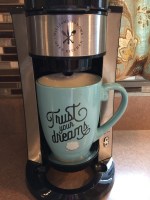
We’ve been in this house for a long time, and as with all houses that are well lived in, the paint and decor have begun to show their wear in many rooms.  I haven’t had a particularly strong urge to change things until I came across a blue that I saw while out one day.  I walked by it again and again…a cereal bowl.   Not needing another bowl, I couldn’t quite understand why it was drawing my attention until I realized it was the color that was captivating me. img_5949Needless to say, the bowl became my color swatch. From there, a sample was brought home, and put up on the wall in no time.  And unlike prior times where I would put up multiples patches of colors to compare, this one sat, alone, on the wall as I watched for how the lighting might change it throughout the day and night.

With most projects, you find an impetus for change and it grows from there.  Since we were going to paint the walls, well, we needed to paint the ceiling.  Because we were painting the ceiling, it seemed right to change out the light fixtures that we had always wanted to change.  And what the heck, since we were changing things, why not add a tile back splash to the kitchen counters like we had wanted for some time?

img_6546With only a color for the wall, things began to weave and take shape, though I really had no other thoughts about the change. Browns, blues and gold became the palette that showed itself to me in all sorts of ways. New fabrics and metals came with new bar stools and lighting.  I found myself sewing basic window dressings and hanging up new and old picture frames that refreshed this treasured living space.  Before I knew it, and with a little trepidation, the “dream” of change had begun to take more shape. All the while, I wondered what it would look like when it was finally done.  I pondered whether people would like it. Would they fail to understand the tie in of light touches of gold and the blending of the browns that had fallen into place? Deep down, would they see this vision, my new borne “dream”, the way I was?

Along the way, when all that could be seen were bits and pieces, I would occasionally hear my husband cautiously say, “I am not so sure about that.”  I would smile and say, “Let’s see how it plays out.  We can always return it.”  As everything finally came into its proper place and the last finishing touches were put on, I found myself in love with what had come to be.  My husband, smiling, repeatedly shared just how much he, too, loved the new look. Those who walked into the kitchen remarked how amazed they were with it–love radiated from their tones and words.  More than once, we were asked if we had installed new cabinets, which we hadn’t.  People were impressed by the change the color alone had made.  Those few changes had a big impact on the warmness and draw to this place we love and “live” in much of the time.img_6556

It was there, as I stood looking at the words on the mug I had bought, that I realized how easy it is to let the fear of change prevent dreams from coming true.  Trust your dreams implies moving forward, not letting fear stop dreams from coming to fruition.  For some, it might be fear of failure that holds them back. For others, it might involve fear of rejection. Still some might fear that it will be too hard to push through and bring about the needed change.  All these hesitations drawing us back into the status quo.

“Don’t change.  You’ve got it good.”  “This dream isn’t necessary.”  “No one else thinks it needs to be done.”  “What will it really matter?”

Those little nagging thoughts that hold down dreams, and without mercy, seek to devalue such aspirations as worthless.  That discouraging inner voice that strives to defeat the need for change with taunts of failure and vice, dread and scoffing.  As movement begins in aspiration and inspiration, waves of questioning and doubt cascade into the free flow of forward motion sending it backwards, if only for a moment.

You see, the key thing about fears is knowing that we were designed to have them. Fear, in and of itself, is not worthless.  God knew what He was doing when He programmed us to have them.  We just might need to outrun something that can harm us motivated largely by the fact that we are afraid of it.  The feeling of alarm may be the one thing that saves us at an inopportune moment.  Fear has a purpose that gets our attention and, in healthy cases, is trying to protect us.  It is a protective warning system that should draw us away from things that can harm, hurt or destroy us.

But, as with all things, you can have both good and bad…

“Those who cling to worthless idols [fears] forfeit the grace that can be theirs.”  Jonah 2:8

Friends, God does not say in this verse that fear is entirely wrong.  Instead, He qualified fear with the word “worthless”.  That is important to note because if you think that in this life you should never be afraid, you will likely get hurt when you shouldn’t have. Remember, fear has a purpose–by design–and is not inherently wrong.  What is wrong with fear is when we engage in believing and following the ones that are worthless.

Worthless means “having no value; having no value of character or virtue; having no dignity or excellence.” Noah Webster, 1828 American Dictionary of the English Language. Ah, God is now helping us to understand better by going a little bit deeper into what fears are wrong.  The fears that will scream for us to cling to them, the ones that will be most tempting to believe, will be those that truly have no value, no truth to them.  By embracing such fears, your character will not be changed; there will be no virtue gained by staying in place.  You will add no dignity to yourself nor your life nor to the live of others. You will stay in mediocrity instead moving towards and striving for excellence.  Those worthless fears will say:

“Stay here.  Trust me.  It is not worth it. Change is too hard, and fleeting at times, but you can trust me to guide you to staying safe.”

Now, let’s go a little further and look at another word:  value.  In the definition of worthless, we are told that when something is worthless, it has no value.  Why not seek to understand what value truly means?  To see whether it can shine a light by helping us determine how to measure whether our fears truly have worth?

Value stems from the Latin word, “valor”, which means “to be worth”.  Id.  In the definition of good ole’ Noah Webster, Noah tells us that “[t]he real value of a thing is its utility, its power or capacity of procuring or producing good.”  He goes on to remark that things can have an estimated value as well as a real value.  Value also can be measured by price, worth, high rate, importance, and import.  Id.  To understand whether our fears have worth, we must determine with accuracy whether this fear is producing any true good.  We must not believe fears on only their face value; we must truly examine them and their claim of right in our lives.

Can we now glean better that there are fears that have worth, i.e., value, and fears that do not?  God does not say in Jonah 2:8 that those who cling to fears forfeit grace.  He instructs us, instead, to measure our fears by their worth.  For it is when we hold fast to these type of worthless fears–that have no true value–that we lose something that will be better for us.  Whatever that may be lies in the grace that is waiting on the other side of the wall of our fears.

In the synonyms for worthless, listed at dictionary.com, you will find some interesting words–words that can describe how we might feel when under the direction of fears that do not produce good:

abandoned, empty, futile, good-for-nothing, inconsequential, ineffective, inferior, insignificant, meaningless, miserable, no good, pointless, poor, sterile, trivial, unessential, unimportant, waste; fawning, groveling, humiliated, low, miserable, outcast, servile, submissive; failed, unproductive; common, disgraceful, dishonorable, lowly, mean, offensive, shameful, sorry.

Ask yourself this, can you identify fears associated with any of those words?  When you read them do you feel any physical or emotional trigger inside of you?  A desire to look away, shrug off, or stuff down; to dismiss or say it was no big deal as a memory pops forward. Can you trace that back to a fear or the moments it impacted?

Now ask yourself, how many times did that fear lead you to those feelings or reactions rather than protecting you from them?  If more times than not, it led you to feeling miserable because it wouldn’t let you participate in happiness, meaningless because you stayed put, a good-for-nothing because you did nothing, pointless because you never tried, trivial because your fear has removed your self-worth or worth to society, humiliated because you feel like you should have or shouldn’t have, outcast because you are afraid to take part or are afraid you are not wanted, submissive because you are fearful to take a stand, unproductive because fear says there’s just too much to do, disgraceful because fear held you back from doing right, offended easily because fear says you are not as good as they are, ashamed because you are afraid you have no worth, sorry because you are afraid you have messed up yet again…then my friend, my estimation is that you are clinging to a fear that is worthless.

It is not you who holds no worth; it is the worthless fear that has no value.

There is good waiting to be released from the bondage that such fear holds back. There is value in pushing past those useless fears and embracing the grace that awaits on the other side. There are dreams God wants you to trust in, even the simplest ones, if only you would become willing to let go of that which unnecessarily constrains you …

Trust God with your fears; don’t let them be the predominate influence in your life. Examine them; find if they are truly adding goodness and value to your days and moments. And when you find that they aren’t, choose Him over the fears that are holding you back. It is where you will find grace in fullest measure and where your worth will become better known to you, for your value will no longer reside in your worthless fears. Rather, your courage and strength to face the truth of what you fear will become worth more than you can possibly measure.

img_6553

“Those who cling to worthless idols forfeit the grace that could be theirs.  But I, with a song of thanksgiving, will sacrifice to you.  What I have vowed I will make good.  Salvation comes from the Lord.”  Jonah 2:8-9