Restraint

“Yet He was merciful; He forgave their inequities and did not destroy them.  Time and time again He restrained His anger and did not stir up His full wrath.”    ~Psalm 78:38

As we are fast approaching Thanksgiving, I have been contemplating what to write.  I will probably always be able to write about my dad as there are more stories that I want to share, but I also want to be real, to talk about today–what is going on in my life, my heart, right now.

His Word.  For those that don’t know me, I love to be in God’s Word–reading and pondering it.  Many years ago, as I was grappling with whether to place my trust in Christ, I was listening to a woman be interviewed on WMUZ.  She suggested just opening up your Bible and seeing what God had to say to you each morning.  Much to my surprise, I began to see Scripture that seem to speak to my everyday life, sometimes right to that moment.  God would speak to my challenges, sometimes to my hurts, and oftentimes I would see how I needed to work on me.  Later I came across this Scripture that helped me to understand how this could be true:

“For the Word of God is living and active.  Sharper than any double-edged sword, it penetrates even to dividing the soul and spirit, joints and marrow; it judges the thoughts and attitudes of the heart.”     ~Hebrews 4:12
These days, God has been showing me what His Word has to say about the bitterness and anger I feel inside.  Funny, because six months ago I don’t know if I would have recognized it as such.  I had it wrapped up in a pretty package of justification.  Before you think that I am being too hard on myself, let me say that I am not saying I haven’t been wronged or that I never have the right to be angry.  Nor am I saying that anger should never be felt.  Most of the time when someone wrongs you, you feel some anger.  God designed us with to feel a whole host of emotions, and anger is one of them.  Even He feels it.

Anger.  In Psalm 78:38, it says that God had to restrain His anger.  There it is…even God gets angry.  Kind of scary, huh?  Anger almost always is a little scary.  Why was God angry?  It was because He was (maybe still is) unfairly treated.  That is what “inequities” means.  We, as we still do today all too often, were not treating Him as He deserved.  In most cases where I find myself so upset or angry with another, I find God telling me that I am not wrong about how they treated me, I am wrong in how I responded to that wrong.  Remember that old saying “Two wrongs don’t make a right”.  I am His and my behavior, my responses, are important.

God has a lot to say about how destructive anger can be.  “For man’s anger does not bring about the righteous life God desires.”  James 1:20  But He also has a lot of instruction.  “Time and time again He restrained His anger and did not stir up His wrath.”  Psalm 78:38 (emphasis mine).  What I found so beautiful about this Scripture is that it is an example of what we are to do.  While we can’t be God and never will be perfect, God does call us to strive for holiness.  “This will be a sign between Me and you for generations to come, so you may know that I am the Lord, who makes you holy.”  Exodus 31:13.  “For God did not call us to be impure, but to live a holy life.”  1 Thessalonians 4:7

The word “holy” can be overwhelming to think of.  It does mean “to be morally or spiritually excellent,” but it also means “belonging to, devoted to or empowered, by God.”  Reader’s Digest Oxford Complete Wordfinder (RDOCW), pg. 700.  The neat thing is that God is the One who makes us holy; it is not about whether we can change ourselves on our own, but whether we will let Him change us in our imperfections.  My temper, my focus on the inequities done to me (what is unfair), is what God is seeking to change in me.  As I looked at His example, I was amazed at the instructions on how to deal with being wronged:

1.  He was mercifulMerciful means “having, showing or feeling mercy.”  And mercy means “compassion or forebearance shown to…offenders.”  Id., pg. 937.  Hmmm…I have some room to grow.  Compassion is “pity inclining one to help or be merciful.”  Id., pg. 283.  How often do you find yourself giving pity or compassion to the person who has wronged you?  Take a moment to think of someone who has recently wronged you.  Can you do it?  Can you find any compassion for them?

Before you trudge down the road of refreshing your anger, stop and think of this.  Have you always treated God fairly?  Did not God have mercy on us even though we had sinned against Him?  Isn’t it His compassion and grace that caused Him to send His One and Only Son to help us out of our hopeless situations?  Does He not save you daily though you may not always treat Him with the reverence He deserves?  Boy, I see that in me and this Thanksgiving, I want to have a renewed sense of thankfulness for His mercy.  Gratefully, I am finding myself wanting to be more merciful, more compassionate…asking Him to open my heart to that kind of love.

2.  He forgave their inequities and did not destroy them.  How many times do we allow the wrong that someone has done to us to destroy our relationships?  Destroy means to “pull or break down…make useless, spoil utterly…ruin financially, professionally or in reputation.”  Id., pg. 385.   And when I used the word “relationships”, I mean for it to be plural.  Have you ever found that when somebody wrongs you, you’ve just got to share it?  As a result, my anger, my lack of forgiveness, effects not only that relationship but the ones that I choose to fester this anger in.  Being in touch with my anger and not forgiving often causes me to pull away…better yet, let’s be honest, to stay away.  My coping mechanism is usually to avoid.  I often quietly distance myself from too much investment in that person for whatever time I choose to stay angry with them.  And of course, I can find all sorts of reasons to justify that distance both with my mind’s reasoning and the anger in my heart.
Forgiveness is the harder road and part of this instruction.  My forgiveness cannot be dependent upon the other admitting they are wrong or conditioned on hearing them say they are sorry.  God forgave us for our inequities but it is clear that we didn’t stop committing them.  “Time and time again, He restrained His anger…”  Do you think they were sorry and had stopped sinning against God?  Probably not or He wouldn’t have had to restrain His anger repeatedly.  And the example is clear.  I need to restrain my anger (possibly a multitude of times).  I cannot wait on that person to change.  My responses, my reactions, the emotions I allow in my heart and my mind are just that…mine.  That is what God has put me in charge of–my heart and my condition.  Therefore, it is my choice to forgive or to be angry.  As difficult as those choices may be, we have a gracious God who gave us the ability to make the right ones.

3.  He restrained His anger time and time again.  For me, I think this is a big lesson.  I have to learn how to restrain my anger.  Restrained means to “hold back, check, to hold from action, proceeding or advancing.  To repress, to supress, to limit, confine, and to withhold and forbear.”  American Dictionary of the English Language, Noah Webster, 1828.  I have noticed in myself that I often allow my anger to grow.  To proceed and advance in so many ways.  When I become mad, I generally don’t stop myself from negative, destructive thoughts.  I find myself winding up and not winding down.  Here God is showing us that with anger, restraint is part of the key.  There are so many other Scriptures that speak to this.  If we are to be holy, then we must live like Him.  We must not only show mercy towards the other person, but inwardly, we must find the ability to restrain our emotions with the understanding that it is a time-consuming (“time and time again”) process that will be tested.
This Thanksgiving.  So why am I sharing this with you?  As I said earlier, I want to be true to what is going on in my heart.  But also, I thought, maybe–just maybe–you might be able to use this lesson from my life to help you this holiday season.  While there is so much joy, delight and hope in Christmas, we often find it coupled with frustrations, hurt feelings from the past, and strife in our relationships.  You, too, may have frustrations and moments where others wrong you.  Where your feelings are hurt, or a situation rises to disagreements and you feel anger.  I am hoping (and praying) that in those moments, God’s Word today may come to you and help you find some restraint, some mercy and forgiveness.  For that is what this holiday season is about, right?  The beginning of God’s incredible gift of mercy for this world…

“Do not merely listen to the word, and so deceive yourselves.  Do what it says.  Anyone who listens to the word but does not do what it says is like a man who looks at his face in a mirror and after looking at himself, goes away and immediately forgets what he looks like.  But the man who looks intently into the perfect law that gives freedom, and continues to do this, not forgetting what he has heard, but doing it–he will be blessed in what he does.”

~James 1:22-25

“I won’t close my eyes”

Sometimes there are moments in life where something really sticks out to you.  Maybe it is a phrase, a picture, a song…it just catches hold of you even though you may not understand why.  I find those moments worth trying to remember even though I might not glean, at that instant, why it is standing out to me.  Some call them “God moments”, but often I do not truly see the God part until later when either a better understanding presents itself to me or a gentle peace arises when several moments come together knitted carefully with a purpose.

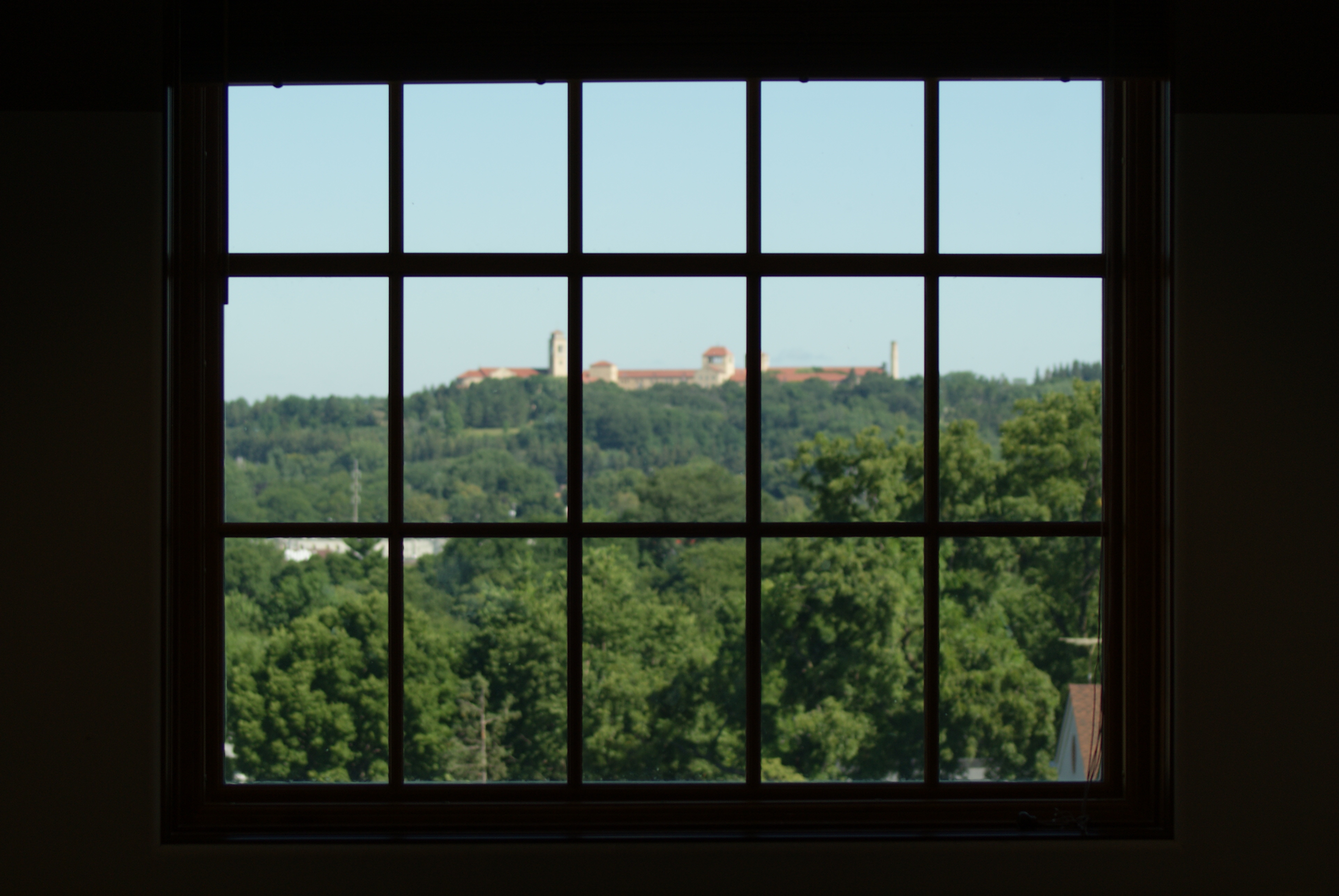
I stood at this window many days and nights in August.  It is in a hallway on the 5th floor of Domatilla 5D at St. Mary’s hospital in Rochester, Minnesota.  The window was just a stone’s throw from my dad’s hospital room and looked out at our hotel.  In the distance, you can see the nun’s seminary over on a distant hill.  This window and another became a refuge for me in the storm of my dad’s recurrent cancer as we met with a slew of doctors, tests and watched him endure waiting, testing, and difficulties that we couldn’t have imagined.  There I would step away–sometimes to place phone calls to concerned family and friends. And sometimes, just sometimes, to look out…

As we learned the news that my dad’s cancer had returned, the pain that we all felt was immense.  We had been told by Mayo in the beginning of his treatment, that if it came back, his life would end quickly.  Inwardly for myself, it was as if someone had placed a grip around my heart.  My chest had tightened, my stomach was nauseous and at times, it hurt to breathe.   For the first couple of nights, I didn’t want to close my eyes not knowing how long I would be able to “see” my dad.  I knew there would be a physical reaction to the news as well as an emotional one, but the pain was astounding to me.  As with all pain, sometimes we want to flee from it.  It was in that moment, standing near this window, that a series of things passed before me as I was pleading with God not to lose my dad.

There was a good reason for the pain.  Really?  What came to mind was several of the women I know…close friends…who have had a lifetime of no father or very little memory of one.  As the pain gripped me harder, it was as if I heard God whisper, “You hurt because you have deeply loved and are loved deeply; you are blessed to have this pain.”  The next day I listened to one of those friends try to console me and I felt empathy for her struggle with the right words.  While I knew that she was sorry for me, that she was truly seeing me in pain, I also knew that I was feeling something she couldn’t and strangely, I found my heart hurting moreso for her.  Later that evening, another close friend shared with me that she felt exactly what God had laid on my heart (before I told her)–and that she had a bit of envy of my pain for in her life she knew she wouldn’t feel that kind of pain with her dad.  That revelation gave me a new perspective on my pain and a different way to see it.

As my dad’s life came to an end, we were blessed to all be by his side as he took his last breath.  For those who haven’t been present at another person’s passing, it can be an unsettling experience.  Over the next couple of days, I listened to my siblings try to process through what was disturbing to each of them.  In one case, it was the breathing…the shallow, raspy, intermittent breathing that draws one’s life to a close and let’s the others know that the end is near.  When I pondered this, I found myself not upset by my dad’s breathing, but by his eye.

You see, my father became more aware the night before he passed.  He was able to talk a little with all of us.  He was even able to respond with a murmured “I love you” when I told him that I loved him.  The night progressed in a way we weren’t expecting.  He broke into a very high fever and his IV line broke flooding his working lung with more fluid than it could handle.  At 3:00am, we phoned hospice to tell them something was wrong and while I was on the phone with the nurse, I told her that my dad’s left eye was remaining open even though the other had shut.  She said it was common and suggested that I take a damp cloth and close it.  The thought horrified me in a way that strongly resonated with me.  I couldn’t close the one window to this world that remained for my dad.

As the next morning came, we all knew the end was near…much nearer.  We were all in and out of my parents’ bedroom multiple times throughout the day, and I kept seeing something different about his eye, which was still open.  Finally at noon, I told my siblings that I felt strongly my dad was still there.  I wasn’t sure why but I was pretty sure I had seen him looking out.  At this point, my dad had lost all control over his body and was not responding anymore to touch.  Later as I sat down near his bedside, I understood what I was seeing.  My dad’s pupil was just above his eye lid, so most of the time you could only see his iris.  What I was observing was him bringing down his pupil and looking out.  It was a painful realization and one I found myself grappling with days later.  The torment of being trapped in your body, the inability to move anything to signal that you are there.  And worse in a way, nothing I could do to help him.  For a brief moment, my heart sank but I believe God brings things to our attention for a reason and I found myself readjusting how I was responding to my dad…that no matter how I had quietly wished he was gone for his own peace, he was very much there.

Around 1:30pm that afternoon, I came into my dad’s room and bent down.  Despite his pain, I put my arms around his shoulders and layed my head on top of his head.  I told him how sorry I was for his pain and how much I loved him.  Then I sat down.  To my surprise, a tear had formed in his eye and I realized he was crying.  My heart broke and I immediately hopped back up and hugged him again only to see more tears flowing from that eye.  I started to cry too as did my brother and sister who were near the foot of the bed.  To this day, I am not sure if they realized what had happened.

And that became my question to God…my struggle.  Why?  Why did he have to be in that condition?  Why did he have to feel that pain…that level of physical pain?  How hard it must have been for him to see all of us in pain and the sadness on our faces that he could no longer comfort.  The pain that he could no longer mend for us as our father.  The desire to stay even though you have to go, even though you want to go. How incredibly hard it is to say good-bye.  My dad’s eye became my struggle.  It represented so much of what I couldn’t understand.

Three weeks later, I stood in my kitchen listening to the song “Any Other Way”.  I knew it was the song I wanted to share with you all in my post “It’s Not Okay”, but as I stood listening to it one more time, all of a sudden one of their refrains jumped out of me…”I won’t close My eyes”.  In the midst of this song about God wanting our pain, not only wanting us to share it with Him, but that we needed to…were these four lines “I won’t close My eyes.”  It was then that all the dots connected.  God wasn’t closing His eyes to my pain.  It was as if He was telling me that He indeed knew my question, and in a way, He was helping me to understand why my dad’s eye stayed open.

My dad didn’t want to close his eye.  He could have closed it as there were long moments when his pupil wasn’t looking out.  He could have shut out our pain.  He could have gone inward and far away, but he chose to stay.  In reality, he could have given up the fight long before the cancer finally took him.  But he wanted to be with us, even in our hurt; in a way, he needed our pain to understand how truly he was loved.  We had walked this road with him the whole way, even to the point of death.  Would he leave us one moment before Jesus called him home?  And what I felt God saying was that the pain I felt so deeply in losing him was the love He wanted him to know.  That pain, though exactly that–physical and emotional pain, was actually for the good.  And my dad’s eye being open was sacrificial love that was willing to be with us through our pain for as long as he was able.  Knowing the depth of his love and his strength of his perseverance to be with us to the very end…that is truly a gift.

And in case you are wondering what happened to his eye?  Was there some chance it was locked open?  Did he really have the ability to shut it?  How can I be sure that he wanted to stay?  As we walked my dad home with warm encouragement, quiet tears, a little laughter, lots of love and assurances that we would be together again, my dad took his last breath and headed home, gently closing his eye all on his own…I remember being joyful at that very moment that I hadn’t taken their advice and shut it.  Trusting God and the nudges to pay attention, I now understand…it wouldn’t have been love any other way…

“Since the children have flesh and blood, He too shared in their humanity so that by His death He might destroy him who holds the power of death–that is the devil–and free those who all their lives were held in slavery by their fear of death.”  Hebrews 2:14-15

“It’s Not Okay”

I personally believe that there is always something to be learned in any situation in life.  That doesn’t mean that the lessons are easily absorbed or the meanings readily apparent, but I try to keep my eyes open and my heart willing to learn.  I believe these lessons are available to us to the very day we die.

In August, my dad’s esophageal cancer reappeared in his left lung cavity.  It made a startling and viscious come back that took my dad from feeling good to incapacitated with severe pain.  From the get-go, my dad didn’t want to die.  He loved life and he loved us.  While he kept reassuring us that he wasn’t afraid to pass, his actions and fear sometimes spoke louder than his words.

Often in life, it is so much easier to avoid the pain, to speak the words that people want to hear, to put on the happy face and say everything is okay.  Even for myself, I often see in people’s eyes that they want to hear nothing less.  I wonder why that is.  In the Bible, the false prophets of Israel continuallly gave the message, “Peace, peace.”  To me, our desire to hear those words are our way of avoiding the difficult, the unfixable and the painful.  Those things that will take hard work, healing and a willingness to look at the ugliness and sometimes, the wounded parts of our lives.

As my dad’s cancer continued to grow in early October, we believe it invaded his brain and bones as well as his lung cavity.  At Mayo Clinic, he had a pain pump installed to deal with the pain that was ravaging his body.  After a short stay at a local hospital, he became very dehydrated.  His pain pump stopped working effectively as the pain medication could not travel throughout his body without fluids.  This dehydration brought us back to another emergency room.

The doctor at his pain clinic had told us why the pump wasn’t working as effectively and why my dad was in such horrific pain.  As we sat in the office, my dad agreed with my sister and I to go to the local emergency room.  He excused himself to the restroom and then had a breakdown.  He was so exhausted, so tired.  He had fought this cancer with such a valiant effort and in that moment, he suddenly realized he was dying.  It was one of the more painful moments in my life.  He looked up and asked my sister and I if that was indeed what was happening, and I couldn’t lie…all of the things we didn’t want to see, didn’t want to admit, were staring us in the face…his life was coming to an end and we couldn’t stop it.  He started to sob, which my dad didn’t do all that often.  We were all crying, but you could hear in his wails the sadness of having to come to terms with something he didn’t want to accept.

Later as I came along his bedside in the ER, I reached over to touch his arm.  Without even thinking, I said, “It’s going to be okay, dad.”  My dad looked up at me and said, “It’s not okay; it’s not okay, Michelle.”  And there was that lesson.  So alarmingly clear.  I realized in an instant that it truly wasn’t okay…nothing about it was okay.  In my fear and my desire to avoid the pain of losing him, it was easier to say it was going to be okay even though it wasn’t the truth.  My dad didn’t want to die.  None of us wanted him to go.  His pain wasn’t okay; it was terrible.  His cancer was winning.  Nothing about that moment, or the moments ahead, was okay.

Over the last several years, I have been researching and studying trauma.  One of the things that I have gleaned is that you can’t gloss over it.  When it happens in your life, sickness and disease are sure to come when you pack it away to be reviewed later or when you file it in the “I refuse to look at it” folder of your brain.  The words “It is not okay” resonated loudly to me inconjunction with that research…that to embrace the truth of the situation was so more real, more validating than pretending in the midst of the face of death that it wasn’t there.

For the remaining four days of my father’s life, I found myself absentmindedly repeating those same stupid words.  They would spring out of me before I could even reel them back in.  My dad, at that point, couldn’t speak anymore.  I would quickly recover with the acknowledgment that “Everything isn’t okay, dad.  I am sorry for those words.”  As the end drew nearer and God came closer, I would add “But soon, it will be.”

After he passed, I was left with the reminder of how strongly it was rooted in me…the need to say that everything was okay.  I could see it on the faces of those who came to mourn with us.  While they gave their polite and caring nod to our grief, you could see in their eyes that they really wanted to see, hear, and know that “everything is going to be okay.”  In my personal life, I found myself saying the same things to strangers and friends alike when right below the surface, I didn’t feel okay.

Then I thought of all God had taught me and my dad’s stinging words, and took a deep breath.  My life isn’t okay, even if that is hard for someone else to hear.  There is a beauty and realness in those words.  There is less of a struggle and more freedom in that acknowledgment.  The pretension goes away and the expectations of others lighten.  While I know someday it will be better, I don’t want to pretend anymore when it is not.  I want to be real.  I want to have the courage and strength to say “It is not okay” even when it exposes my vulnerability, even when it is difficult, and most of all, when it allows me to process through instead of avoid that which is painful.

And it seems everywhere I turn as of late, that is sticking out to me.  The desire of so many to gloss over difficult things, to demand that others suck it up–“be tough”, to look the other way when the pain of another’s situation is more than you can do anything about.  It is in these moments that I remember God’s Words to Paul:

“Three times I pleaded with the Lord to take it away from me.  But He said to me, ‘My grace is sufficient for you, for My power is made perfect in weakness.’  Therefore, I will boast all the more gladly about my weaknesses, so that Christ’s power may rest on me.  That is why, for Christ’s sake, I delight in weaknesses, in insults, in hardships, in persecutions, in difficulties.  For when I am weak, then I am strong.”  2 Corinthians 12:9-10

I know God is encouraging me through this lesson to learn to admit when things are less than perfect.  To be able to utter the words that everything is not okay when that is the reality.  So I am taking a deeper look at everything.  I am listening to myself when I find inwardly I am cringing or feeling fake about what I am saying.  I am opening up my heart and asking God to help me see where things really aren’t okay.  Why?  Because it will be with God’s guiding hand and my willing heart that I will be able to acknowledge those areas that are indeed weak so that God in His strength can bring healing, resolution or the peace of being able to let go.  It is in His strength where I can admit my hardships, weaknesses, and difficulties so that I may find true healing…His healing.  It is there where it will truly become okay.

Postlog:  As this post came to me, I was sitting in the parking lot of a coffee house listening to a CD by Tenth Avenue North.  I had been pondering this lesson for awhile and the song “Any Other Way” came on.  I had listened to that CD a bunch of times before but had never heard this song.  Please take a moment to listen.  It is amazing that God speaks to so many of us about this very issue…the truth of our lives is so important to Him as well as His desire for us to truly heal from that which pains us.  I know there will be more to be learned and more moments of grace.  May His love find you broken and longing for His healing touch.

A short video by the songwriter (click on the arrow button in the middle of the picture to play the video): 

The Song: