
My “gram”, as she became known to me in the last two years of her life, was a survivor. More than that, often a fighter. She was known to be feisty, opinionated, and a hard worker. She fought to feed her children during World War II, and battled to keep her son (and several other soldiers) from feeling forgotten by writing to them while they were in Vietnam. She didn’t like women being put down as useless or worthless, and made sure most knew she wasn’t going to allow them to walk all over her.
In her younger years, she wanted people to have a choice; something that can’t happen when there is only one option. She, along with three other women, brought in the Democratic party into their hometown and found a candidate to run for office. They canvassed the surrounding towns, and a couple of elections later, they got someone into office.
It was almost two Octobers ago when she experienced a bad fall. At 94 years old, she was still living independently on her own. It was the second fall, less than a week later, that landed her in the hospital with a death sentence that required she go to a nursing home to be cared for. It was there, that “gram”, my cousin’s affectionate name for her, took hold.
I remember walking down the hallway of the hospital after that second fall. The news had arrived a couple of days before, but I had hesitated to go. Not because I didn’t want to see my grandmother, but because people in my extended family had expectations that were not fair of others. Others, specifically, me and my cousin. They knew that I could advocate and manage health care situations well. They knew she was great with details and arrangements. Together, I was confident, they would think we were the perfect team to take care of her.
And so, if I stepped forward too soon, they would likely disappear back into their “busy” lives; all those who could and should be caring for her. Without fail, this attitude poured out of them at later hospice meetings.
At the door to her room, with open arms and looks of relief, they smiled and warmly welcomed me. “I am so glad you are here!” “We need your help.” “See, she’s going to die soon,” as my grandmother looked up and smiled with her bright blue eyes. She didn’t look like she was dying. In fact, she was sitting up in bed giving orders like she always did.
“Oh, but the doctor said, she only has 5-7 days left.”
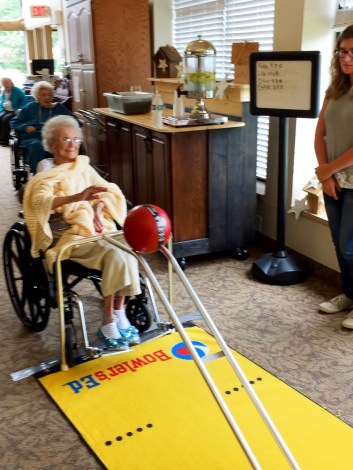
Almost two years later, my gram just passed away. This picture was taken just a few weeks before her passing. Doesn’t look like she was so near now, does it?
Two years later, with no one by her side when she took her last breath.
Alone, despite an abundance of children, children’s spouses, grandchildren and great grand children. Not even a nurse or an aid present. Alone. Her last breath somewhere in a thirty minute spread that we will never exactly know when it happened.
A tale I tried hard to prevent. A statistic I never thought my family would be a part of, even in their worst moments. A tale that is too frequent in nursing homes, hospitals and home settings. A trend that estate planners are seeing grow at a terrible rate, and one that is a horrible reflection on what is going on in our society.
It is a tale that left me weeping for two days rather than rejoicing that she is finally free and at home in God’s arms.
A tale that must be told.
You see, I didn’t grow up super close to this grandmother. Everyone who saw me visit or advocate for her always thought that must be what motivated me to check on her so frequently. Actually I was not close to either grandmother. My mom’s mom died when she was very young. My step grandmother had some good moments, but too many of them were spent on her bathroom floor scrubbing little one inch white tiles with a toothbrush. “I am going to teach you kids better than your parents do” often rang out from her kitchen or living room. Too many moments like that to disregard and label as “love.”
This grandmother, my dad’s mom, lived in another state through much of my childhood. We saw these grandparents at the holidays and the occasional vacation. However, at some point, they moved back to our state onto a lake. From that point on, we could visit them regularly and did for a couple of years. There were no bathroom scrubbing or harsh chores. There were no assumptions that we were “bad” nor any undercurrents of resentment and dislike that we didn’t understand.
Instead, there was a set of jars.
I rem ember seeing them and being in awe. My step grandmother especially loved dinner time. But not in a good way. Food was not a pleasant experience for any of us children, so these jars were fascinating.
They were filled with things like Hostess cupcakes, candy, Peanut Butter Cups, Ho-Hos, and more. Just sitting there.
I remember asking my grandmother about them. She smiled as she cooked breakfast, and said, “Take one whenever you want. They are there for you guys to enjoy!” I could scarcely wait to lift the lids to peak in. Soon, it became a morning ritual when we were visiting, to grab a cupcake and head out to the dock. It is one of the fondest memories I have of her, and now I have my own set of jars.
Now my grandmother was not a saint. None of us are. As the years went by and time and distance passed, she developed strong relationships with some of her children and grandchildren while letting the others be more distant. We had the obligatory family functions, but outside of that, there was little contact on a regular basis. And by then, as an adult, I was already living my own life well without that relationship developing further.
But many years later, my dad got sick. Then he passed. Six months later, his oldest sister died too. And there was my gram, at the second funeral of another child, when I started to wonder what was in store for me ahead in the end of her days…
So many people believe that living a Christ-centered life is professing Christ front and center in your life constantly. Words blaring, no one can miss the testimony. It is loud. Sometimes harsh and judgmental, but assuredly, meant not to be. Oftentimes, their words assume you couldn’t possibly know Him because you haven’t “heard” their story, been to their church, or confessed your need for Christ directly to them. This is especially true if you are not also being loud about Him to others. It is displayed faith that can’t be missed.
But, my friends, faith is not about what is spoken. It is about what is lived. It is about how you live. And most importantly, how your life impacts others. We were not put on this world alone, nor was that His design. Our faith isn’t meant to be spoken into lives but impacting them by how well we live our days.
I was on vacation when the call came two weeks ago. “Gram is being taken to the hospital. Her foot is black and it is going up her leg,” my cousin said, who was extremely close to her. Her voice cracking and unsure. I picked up the phone and called my mom, asking her to join my cousin at the hospital to see what was going on and advocate for her since her dementia and understanding would be limited.
I arrived home a couple of days later and went straight to the hospital. Her pain was still not fully under control. It took another 48 hours for hospice and the hospital to get her to a restful state–often under the constant watch of a loved one, an advocate, who could speak up when she displayed discomfort. A lesson I had learned long ago. Hospital and medical staff mean well but they are often over-tasked with too many patients making it hard to be readily available. It is why people in the hospital need a constant advocate, especially those with limited cognizance.
Once we got ahead of the pain with the medicine distribution, it became a waiting game at the hospital with my gram moving clearly towards home. Her days were numbered and hospice estimated that she would pass in 24-72 hours. As I sat with her, and in her room for hours, I began to notice that people really struggled to do the right thing. I began to hear things that weighed heavily on my heart as she laid there with her eyes closed, ears still listening, unable to move or talk.
“You need to worry about your own health! You can’t stay here tonight (or another night)!!”
“I’ve already said good-bye to grandma. I am just here to support my parents!”
“Why does she have an IV? She is supposed to be dying!”
“I am so glad she has you to take care of her and be here for her.” Let me translate this, “I am so glad I don’t have to do this!”
“It is just tearing him apart to see her. It took him a half hour to stop crying! There’s no way he can come back.”
“I just spent the last three hours outside at a wonderful picnic of a good friend who made some fantastic Indian food. It was so great!”
“No one should have to go through this! We should be able to end our lives when we want. I don’t want to be like that.”
“He needs to tell her all that he is upset about before she dies so that he doesn’t feel bad the rest of his life. I don’t want to lose him because he is filled with hate and resentment.”
“He will stay the night with her. You don’t need to come back. We won’t leave her alone.”
Should I add in any more? Do you see why I wept for two days after hearing that she had, indeed, died alone. Without an advocate despite doctors and tests scheduled to come that early morning. Without a voice, when an abundance of voices were able to speak. No one to stand in the gap of the night and early morning as her soul journeyed home.
Nine hours. Nine hours of new medications that we weren’t sure would keep her comfortable. Her IV had fallen out and couldn’t be reinserted. A transition that should have been managed closely in light of our experiences, but wasn’t. Three hours of phone calls to hospice to make sure the right oral medications were distributed and that it would need to be closely watched, followed by reassurances that they would.
Words, my friends, don’t prove faith. Actions do.
“The Lord is a jealous and avenging God; the Lord takes vengeance and is filled with wrath.” Nahum 1:2
And that is why when I read these words, I felt a strong nudge to share them. May it help you to see what you choose to do (or not do) does, in fact, strongly matter to God as well as impact others and their journeys. Choosing right over wrong isn’t an opinion; it is the foundation of character and integrity. When we choose not to do right, it can’t just be swept under the carpet as not mattering.
At Dictonary.com, it states that when used in the Bible, “jealous” means that God is intolerant of unfaithfulness and rivalry. Folks, I think He is speaking here of the crisis that is occurring in our world. People not caring for people when they are more than able to; when they are supposed to; when by the basics of humanity, they should. God pointedly gives each of us this task with the relationships He has given to us or the path of another He has placed into our lives. In His Word, He continually instructs us to take care of our families, our elderly, our widows, our parents, our children, the orphans, the injured, the aliens, the poor, the needy, the sick, the imprisoned, the hopeless…
Nowhere does He instruct, “Pawn it off on another.”
He doesn’t qualify it with “only do it if you have time.”
Nor does He say, “Go to the picnic and eat, drink and be merry…for your grandmother doesn’t need comfort in the end moments of her days. Her caretakers don’t need support and relief.”
He doesn’t yawn and murmur, “Sleep, do not worry about what there is to attend to. It will surely be there in the morning.”
Paul, the great apostle, traveled by the direction of the Holy Spirit, to visit disciples while having a thorn in his side, being beaten, chased, threatened, shipwrecked, and the list goes on and on. While we will all have days where our health is not at its best, should we be using that to justify being apart in the last hours of someone’s life when it is really not emergent?
You might wonder about “rivalry” but this seemed clear to me. All I heard for the five days I was at the hospital was family members repeatedly comparing, competing and trying to outdo each other with who had the most going on or the hardest time. Let me prove that I can’t do this and you can, or I am doing this and you are not. “Rivalry” seems like the perfect word to use when we seek to prove our claims over another. But I think there is more. Is it possible that we are provoking God to anger when we tell Him that our “plans” are more important than the mercy, kindness or comfort we may be able to give another at that time? Might our excuses and justifications rival God’s will in our lives?
“The Lord takes vengeance on His foes and maintains His wrath against His enemies.” Nahum 1:2
Whew, that’s a little frightening! So glad this is not me! I could never be a foe or enemy of God. I am saved; I am “good” with Jesus. Really? I think that self-righteous mentality creates a lot of problems in this world and with God. A “foe” can be anyone who feels enmity, hatred or malice towards another. But better yet, it can be someone who is opposed in feeling, principle, etc…to something. What about God’s principles of kindness, love, mercy, forgiveness, truth, hope, taking care of others, being the Good Samaritan when there is nothing to be gained for oneself? How often do we check to see if our choices are at odds with any of God’s principles, instructions, feelings, etc.? Can we put down our selfishness–our plans, issues, excuses–long enough to be His vessel of light or love by how we treat another?
Enemy is even better. Of course, it can be someone we feel hatred towards or who feels it towards us. But did you know that we also become an enemy when we foster harmful designs or engage in antagonistic activities against another? You better believe I put a stop to the idea of my gram having to listen to her child, who has had many decades to deal with his and her issues, unload on her at this point in her life. How the heck was that design in line with her best interests or what God wants at the end of a life? What happened to walking someone peacefully home? Or how was it not antagonistic for a son to demand answers for why we were insisting on her having an IV when it was the best method to hold back the building pain of her dying and rotting leg? A process, we were told, that held a very large potential to be unfathomably painful even with pain medication.
An enemy can also arise from something harmful or prejudicial. The obsolete definitions included inimical and ill-disposed. And by golly, I am not so sure those parts of the definitions should be considered obsolete in our current world. “Inimical” is when you are unfavorable or have an adverse tendency toward another. Further, when you are cold or unfriendly. Ill-disposed is being unfriendly, having a negative attitude, being unsympathetic; best yet, having an objectionable attitude. And prejudice contains lots of definitions but what struck me the most was when we choose to harbor unreasonable feelings, opinions or attitudes, especially ones that are hostile towards another. All of those definitions are readily available to explore at http://www.dictionary.com. Sadly, they are lived out frequently in settings where someone is dying as well as in the lives of many in our nation.
How is it that we have become so lost in our own little worlds that we don’t realize our actions and in-actions hold the potential to make us enemies and foes of God? How have we become so very blind to the impact of our choices? She was 95 years old with a few remaining children left, fifteen or more grandchildren, and oodles of great grandchildren. She had spent the better part of her years, imperfectly, being there for them. Nodding her head, putting out jars of goodies, and opening her door whenever they found the time for her, even when most just wanted something from her.
I find it interesting that when we find someone repeatedly choosing not to be angry with us even though they could be, most delude themselves with the idea that that person has no reason to be angry. All is good and right because there are no consequences. Our choices must not have really mattered. But let us beware of that:
“The Lord is slow to anger and great in power; the Lord will not leave the guilty unpunished.” Nahum 1:3
Just because God is slow to anger, even though He holds the power to greatly display it, does not necessarily mean our actions and choices are okay with Him. This family had a lifetime to do right by her and most never did. If God is all about love, truth and righteousness, can this really go unaccounted for? Is His gospel that cheap that there are no consequences for wrong and harmful choices?
Let us all think on that for a bit.
Our choices have consequences. We can trust God for that and with that. May our country, our families, our world, and those in it start to pay attention to the idea that speaking of God as if we know Him isn’t a pass on doing His work in this world. Choosing to ignore or turn away from the right decisions and actions have a negative effect on this world, on lives within our reach, on relationships that could exist but can’t in the vacuum of “I only do what works best for me”.
Nine hours doesn’t seem like that much, now does it?
Nine hours to make a difference in a life…
Gram, may you rest in peace knowing that we are truly so sorry for trusting those we mistakenly thought would value the little time you had left. We have been given peace that you know we would have not left you alone had we been given a choice.
Heavenly Father, thank You for helping us to come to terms with the end of her hours. May we trust You with our days ahead and give this world the best we have to offer, instead of nothing or very little in the way of empty words.
“The Lord is good, a refuge in times of trouble. He cares for those who trust in Him, but with an overwhelming flood He will make an end of Nineveh; He will pursue His foes into darkness.” Nahum 1:7
 Washing My Windows