What are you turning into?

All weekend long the word “turn” repeatedly made its way into my thoughts.

My sister, Rebecca, once pointed out to me that I have a tendency to turn away when I am mad, and in that turning, it hurts.

Over the last couple of weeks, I have spent a lot of time reflecting inwardly on something that had really bothered me.  In the beginning, I was stuck dwelling on just the situation, the “impact” of what had happened.  And then, out of the corner of my eye, I caught myself “turning” away from that person.  Quietly, I thought of my sister’s observation and began to ponder what that truly meant.

As I contemplated the series of events that set this hurt into motion, I decided to become more purposeful in watching myself…to see what I was doing and how.  What was I turning towards?  What was I turning away from?  And just as importantly, when and why?

I found that it is very easy to turn away from pain, especially when the pain is deep and penetrating.  I know I am not alone in this.  Oddly, I have counselled many to not turn away from the painful moments of life and relationships as it is a very common approach for many of us…to  move away too quickly.  But pushing away seems so natural; our first knee-jerk reaction to something that hurts.  It is so innate that I wondered is that maybe how we are designed?

What I also found is that it is incredibly hard to turn away from love.  Those feelings don’t just go away easily even though they may fade into the background during certain moments.  That if you are willing to see love, you will not be able to turn away from it.  That it burns brightly in the heart despite pain, hurt, and sadness, and even when the mind doesn’t want to engage it.  That if you listen carefully and pay attention, you will find it there waiting to shine and be restored. But, as with all of life, there is always a choice…do you choose to see it?  If you choose to deny love and move away from it, then much like a small flame, it can flutter out in the midst of your movement, only to be left behind in a pile of ashes.

One thing that I hold in amazement is that God has not only created our world and everything in it, but He has also given mankind the study of science to help bring about better order and understanding.  I like that, oftentimes, science can give us even bigger insights into ourselves and the world around us.  I don’t see God and science as mutually exclusive as some do, but instead, I believe they are working together for those willing to see.  That, as if in a dance, God brings us illumination through the art of science so that we may that bring light into this world in a way that dazzles the mind, the body and the soul.  So I wondered, is there something in science that might help explain this natural tendency to turn within us, the turn I was feeling in myself?

Well, lo and behold, I believe there is!  I spent some time in a physics classroom of sorts strongly pulled to learn more about the laws of motion and how we actually physically turn.  I hope I don’t lose you here (and I can’t imagine I will as this is physics in its simplest and least complex form if I even dare to call it that), but let me–unprofessionally, of course–share a little with you about what I learned about turning.  According to Newton, Isaac Newton–a legendary scientist and believer in Christ, once an object is set into motion (I like to think of our lives as such since they are always moving forward), it will continue in motion at the same speed in the same direction for…potentially…ever.  It is only when a force, an outward force, is applied to it that an object will either reduce or increase speed, stop or turn.

So basically, here we are chugging along in space on our paths and it all seems like it is going along smoothly and steadily.  How many of you have been there?  Days run into one another, and everything has its routine.  There’s a state of ease to some degree and a sense of calm.  The world seems pleasant and all is right.

You may not even have realized you were on such a straight path until you were knocked into a state of fluctuation.  Maybe a job loss, a death of someone dear, an illness, a car accident, a tragedy of violence, or something–something even as simple as a painful or emotionally wounding comment; whatever it might be, it catches us off guard and knocks our world a little out of balance.

I think, my friends, this is the point–this point of impact with an outside event–where we have the potential to be sent into a turn.  You see, when an object has force applied to it by another object, there will be a reaction of some sort.  If the object is not stopped, it responds by going in the opposite direction.  Amazingly, while it might not complete a full circle, a turn is almost always a part of the movement and it always has a potential to become a circle.

Now guess what way an outside force causes an object to turn naturally?  Inward.  Yep, it is theory of centripetal force.  The natural tendency of an object to turn towards its center.  I think this might help explain why we have a natural tendency to turn into ourselves and away from another in the face of something upsetting, shocking or hurtful…from a force applied, we move in the opposite direction.  While there might be an initial reaction to the collision, it is likely that most of us will turn inwards towards ourselves for protection, restabilizing and comfort.  I believe this is very much how we are designed.

But do you want to know the really mind-blowing part?  When we turn, we actually accelerate into the turn…the turn inwards.  So I wonder if that is where we get stuck sometimes?  What was designed to help us avoid or deal with an intrusion from another source, also has the potential to send us into a spiral of sorts that draws us inward more.  Think about it, when you are hurt, don’t you normally draw inwards?  Let’s just look at something simple.  Someone does something hurtful.  How often do you really confront them right then and there?  Or do you turn away, regroup and not share the pain until you are safely away from that situation?  When you feel like you are in a safe place where you can process the event without the infliction of more pain.

So it appears that we all have a natural tendency to pull away from painful conversations, comments, events, or perceived hurts.  Nature appears to have designed me such that I will not naturally move towards a situation that has inflicted pressure or pain on me.  I am guessing neither will you.  That all of us, whether apparent on the surface or not, will move away from that force as it is part of the natural order to things.  And even those that appear to confront on the surface will not be able to resist the pull that we are naturally designed to move inwardly to safeguard ourselves.  That even they will experience some sort of turn in their hearts, thoughts or attitudes that draws them away from those that they perceive to have inflicted the hurt.

So how does that apply to myself?

Well, my sister was partially right.  I truly do have a tendency, at times…oftentimes…to retreat after an upsetting situation.  To turn away from what I perceive to be painful and frustrating.  Don’t get me wrong, in anger, I can confront.  In justice, I can sometimes step out and step in.  But in the hard parts of working through relationships that are experiencing difficulty, I am finding that I do often step away, turn away.  And sometimes, it is easy to follow that turn inwards and let it accelerate…because it feels so natural.

However, with a new understanding that this is a natural response, I am now looking for more clues on how to better navigate such impacts.  Much like an icy road and the spiral that can result from overturning, I want to learn how to turn just slightly enough to rebalance my life, my thoughts or my heart.  To embrace a turn as part of the response, but not so much that it leads to too much distance.

Once I sat with Josh at a meeting on learning how to fly remote-control airplanes.  I was struck by something the instructor said.  Each plane has this small remote box with often two even smaller handles on it.  It is by those handles that you control the plane–up, down, left, right.  He told the group that the natural tendency of everyone is to push the control handles sharply one way or another, with big movements–pushing hard, instead of softly.  But gently was really the key.  It is in the soft, gentle movements of the pilot that the plane flies the best and in the most consistent order.

That to fly the plane smoothly, the kids needed to train their fingers and their responses to move in small measures.  That it only takes a small amount of force to change the direction of the plane, and that gentle response would be the opposite of what they would naturally want to do.  Amazingly, he was right!  We watched many a child and adult crash a plane in an over-movement of their fingers or too dramatic of a response.

All of this is showing me that I need to pay special attention to my responses, to my inclinations, and hence, most likely, my turns.  Realizing that I will naturally accelerate into my choices based on the measure of self-protection needed in direct relation to the force that I encounter.  But now, with this understanding, I can be much more purposeful about watching, waiting and finding the patience to learn how to counteract those forces best, so that I can have better control of where I end up.

That I am not just shoved into some circular pattern of frustration, anger, fear or regret that I have no control over.  Honestly, we all have control.  Some things we can’t stop from happening to us, but truly we can learn how to better control how we turn and who we turn towards.  Denying how we are made won’t help us make those decisions, but trying to understand our choices will lead us to make better ones.

If you remember, an object once bumped has the potential to complete a circle just from that impact.  Guess where that leads you?  Right back to the point of impact. I have to smile when I think about the design.  I don’t think God really wants us to “circle around” those impacts, though He will let us if we insist!

Ask the children of Israel why they wandered in the desert for so many years…wasn’t it, in essence, because they refused to trust God and move forward, thus, circling a land that should have only taken forty days to cross.  Acting in denial, or accelerating into our set ways, patterns, or fears will only lead us back to what caused them.  We are meant to learn from those impacts.  And who knows..maybe that is how we get stuck on infinite loops of pain with those events we fail to process through, never forgiving the impacts or the wrongs.  Continually revisiting the past, the same land that we’ve seen before, but never being able to see beyond it.

The beauty is that the impact doesn’t always have to end up in a circle.  It is all in how the wheel is handled.  It is in the turn that I believe God wants us to turn towards Him, those we love, and yes, even those we don’t.  While turning inward might help ease the pain for a moment, long-term it sets the stage for damage and distance…something that is even harder and longer to overcome.

Thinking on all of this, I know that’s not where I want to be.  So yes, I am now gratefully watching my patterns, checking my responses, and patiently waiting with eyes open for new ways to turn in gentle, soft motions that correct my path only as much as is truly needed.  Yes, inward is okay, but only for a moment…let us all remember that the next time we are impacted with an unexpected opportunity to turn.  Let us not become cursed by going in circles that lead to only more pain and separation, but let us turn towards one another seeking to get back on the straight path.

“He will turn the hearts of the fathers to their children, and the hearts of the children to their fathers; or else I will come and strike the land with a curse.”  ~Malachi 4:6
Tell it.

My mother-in-law can attest that I was never a big fan of having my picture taken.  While I’ve always taken pictures, in part, to document our life, it wasn’t until two years ago that I really began to appreciate the power of a photograph.  Thanks, in large part, to my love for creativity, my dad’s terminal diagnosis, and two bloggers committed to the power of pictures to tell a story…Ali Edwards and Becky Higgins.  Their blogs and projects inspired me, and a few on-line photo classes, after the gift of a new camera, led me out of my shutter fear.

For a long time, I looked at photography with a certain level of formality.  They were preserving a piece of the past.  Yet, when I looked at really old, old pictures…you know…the black and whites from days gone long by…I was enthralled.  Who were they?  What were their lives like?  What did their relationships hold?  As pictures were expensive, many of those photos contain people dressed in their best, stiff and proper.

Looking back at pictures of my youth, I find an even stronger sense of connection.  Seeing pictures of me, that I can barely remember, standing with our Great Dane, Alex, or hanging on to a stuffed animal dressed in my favorite pajamas tug not only at my memories but also at my heart.  Those pictures I truly treasure and always have, because they help me to remember what I too easily have forgotten.

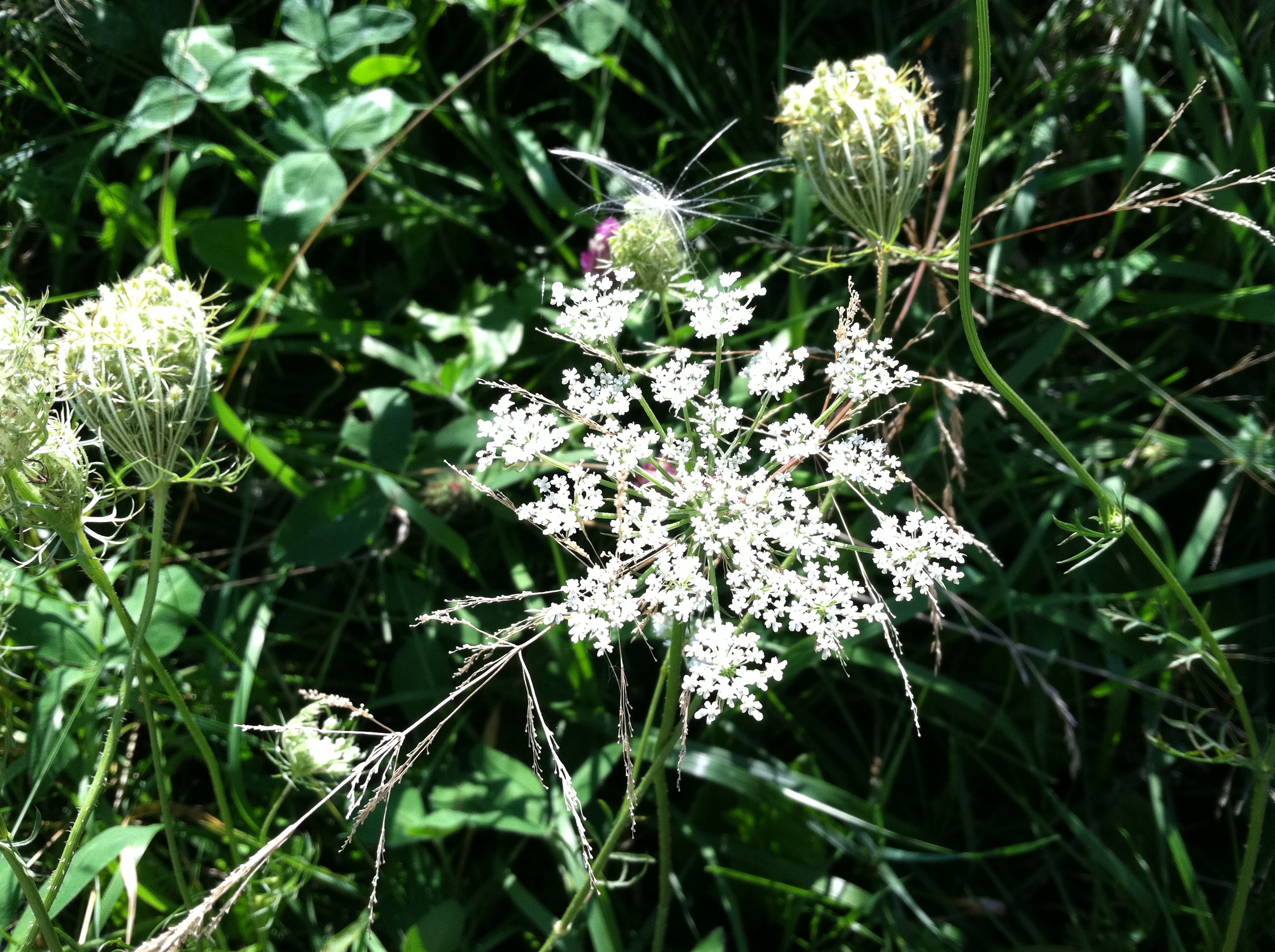
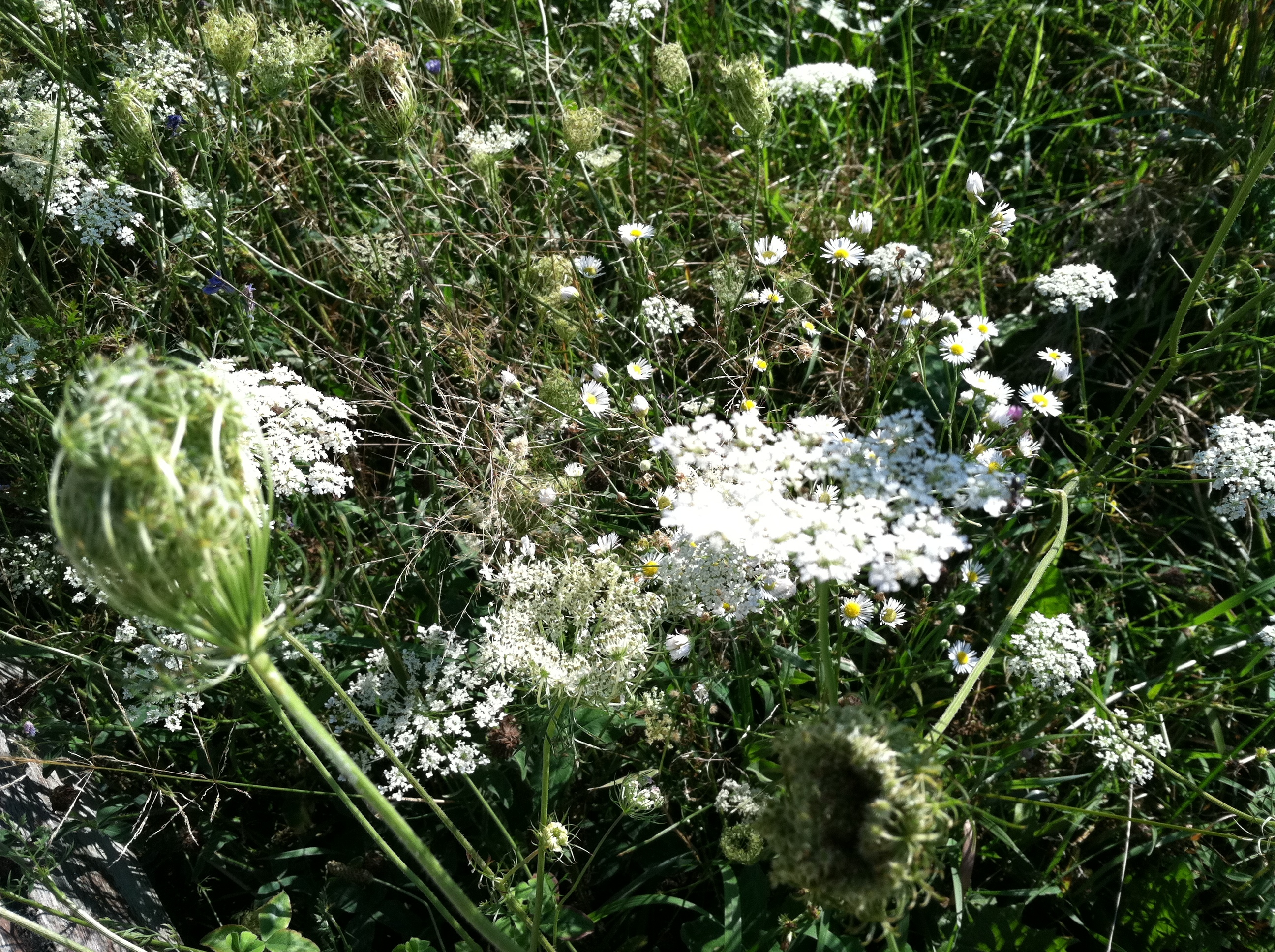
But it was not until this moment…this simple picture that I realized the power of a camera.  That it can do more than document a stage of life, it can capture a powerful emotion.  Looking at this, there is nothing special to it.  It is a picture of “weeds” by many people’s’ standards, but here…it is the moment when I gained a new perspective.

Here I was standing at the gate of my dad’s garden distraught at the idea of having to let go of him all too soon.  Nothing was making me feel better.  Not the tears.  Not the song.  Not the sunshine.  Not the warm gate.  Not being away from the metal bed that spoke of his looming departure.  Not a thing.  I just couldn’t see a way out of the pain.  In facing death’s hold, I could find nothing pleasant.

But as the tears slowed and my eyes began to clear, it was there that I spied one of those little white daisy flowers with the yellow centers.  At that moment, I realized that life goes on.  While I don’t mean that easily or contritely, it was one of my “ah-ha” moments.  I looked at that flower and its simple beauty, and contemplated that life has its stages.  No matter how we try or how much I wanted to argue with it, we can’t get away from it.  However, if we focus on the beauty, then maybe–just maybe–the pain can gain a new perspective even if it doesn’t go away.  That maybe there was beauty right here, right at the same time as this pain.

At that moment, I longed to document that thought as reminder for the days to come.  But I was standing at the gate with no pen, no paper, and little to no energy to go find some.  It was then that I realized I had my I-phone in my hand, and in essence, a camera.  I pulled it out and snapped a picture.  I knew that when I would later come back to the photo, I would understand why I took it.  As I looked through the camera to steady the picture, I felt this calming presence sweep over me.  A peace that I wanted to remember.  And what I found was that as I took more pictures, I found more peace.

And that principle guided me through the rest of my dad’s life.  It brought me courage to bring out my camera or my phone, and take the shot even though I was a little afraid or tired or emotionally spent.

Taking pictures brought me peace when all I could see was pain and turmoil.  Looking through the lens often helped me to regain balance and find fresh perspective.  And so, I found this new passion helping me to record as many moments as I could.

Not just for austerity’s sake but for the emotion that I was feeling…that we were feeling.  Knowing that in the rush of days ahead, we would not remember many of those moments if a picture hadn’t encapsulated and frozen them in time.  That life is filled with all sorts of moments, and it would be a shame–a misrepresentation–if we only left behind for others, the cock-eyed view that life is easy, pleasant, and always good.  That death can only be remembered in an obituary or a memorial card.

What I found with much excitement and hope is that pictures do not have to be perfectly posed to carry their weight and earn their value.  They just need to be about life.  I don’t have to only see smiles to capture the beauty of the day, even when that day is filled with great sadness and a feeling of being lost in a sea of unchartered emotion.

I want my son to look back at those pictures seeing how we lived life both in good times and bad.  That sometimes tears and sadness are the best measure for the situation.  I want our pictures to be about life, real life.

You see, some day, someone will look back and want to know more.  Being that we  have the power and ability, I want show them what our lives were made of.  To feel and read about how we lived life.  I want them to know that our moments had details.  That life is much like a river, it has to be navigated.  So this is my story today, and the motivation behind why I share my photos and my words.  My prayer is that you will realize how important your story is in this journey that we share and call life.

“Tell it to your children, and let your children tell it to their children, and their generation to the next.”  Joel 1:3

In the garden of my memory

Love never fails.”  ~1 Corinthian 13:5

“Love is not proud.

Love does not boast.

Love after all matters the most.”

It was about this time last year when the fields had a golden hue to them.  The sun was still warm, and yet, there was a change in the air.  I remember standing at the gate of my dad’s garden.  This big, billowing garden that used to be our horse arena when I was a teen.  Around and around, I would ride my horse, Buffy, training for our horse shows.

Much time has passed since then.  The horse shows ended as I went off to college, got married, and entered law school.  My dad, in his wisdom and love of gardening, turned the riding arena into our family garden shortly after his grandchildren entered into the picture.

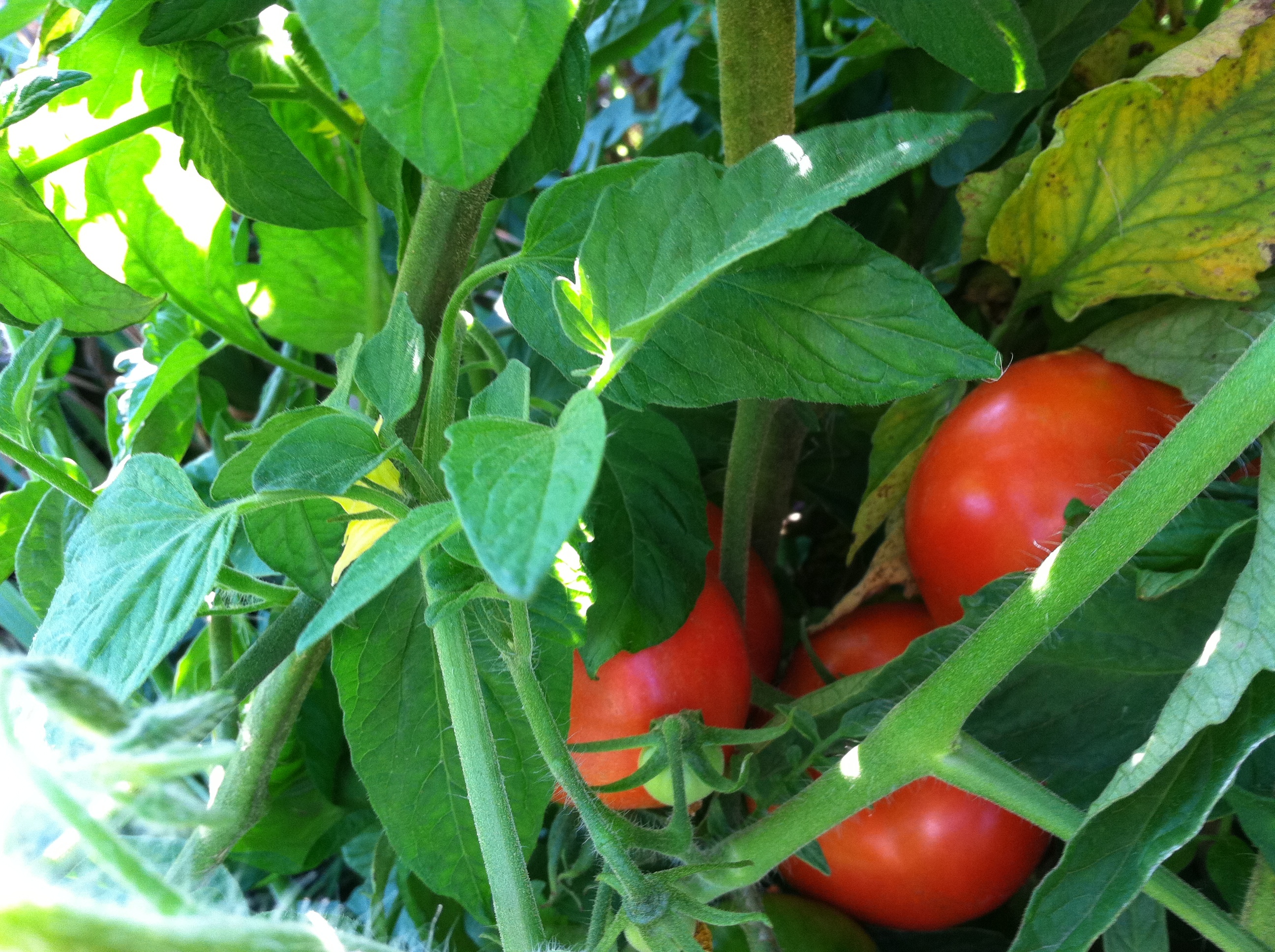
It became our ritual to plant it each spring.  He loved the garden and loved what it yielded.  I learned from him how to can tomatoes, and in the years just prior to his passing, I tried my hand at pickling and salsa.  He loved my pickles, and loved that I was interested in what he loved.

Feeling the warmness of the gate in my hand in the late summer sun, I stood there quietly with tears streaming down my face.  How did we get here?

“Love does not run.

Love does not hide.

Love does not keep locked inside.”

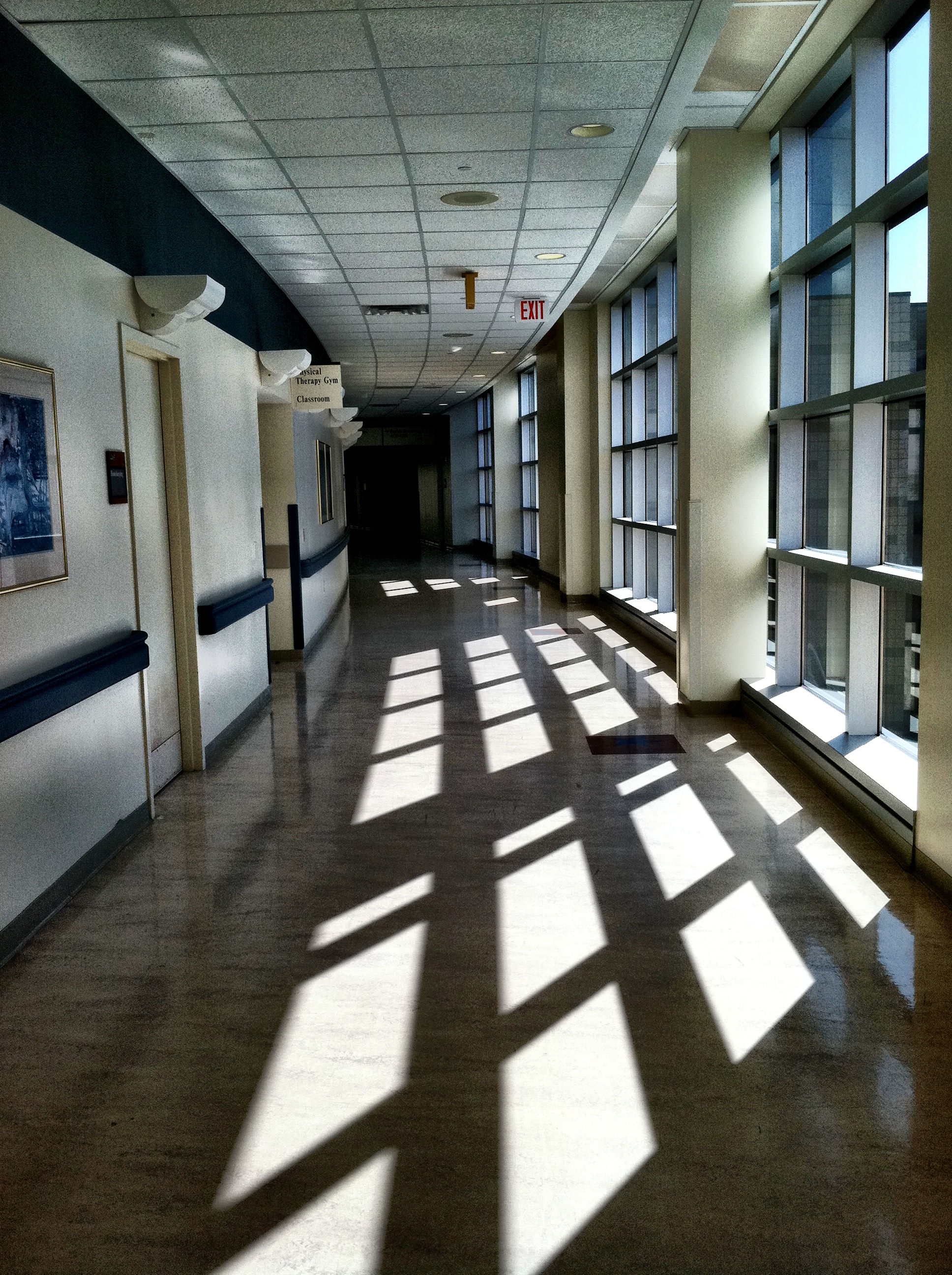
You see, a year ago, right before Labor Day, we had arrived back at his home after weeks at Mayo Clinic.  There we had learned that he was dying.  It was there in a hallway, in my pain, a song spoke quietly to my heart.  As I stood at the fence, listening to that song and looking at the garden, I wept.

It’s funny how we are designed.  Our bodies–they are amazing things.  We are so much more than our minds can comprehend.  You see, when things are scary, uncertain, painful–especially when painful–our bodies detail all of the surrounding information for future reference.  It is how sometimes people get trapped with their memories after experiencing something particularly tragic, like a soldier watching a friend die in a battle.  But it also happens in the tragedies of life that befall all of us.

“Love is the river that flows through.”

It has been awhile since I have listened, truly listened, and thought upon that song.  However, the other day, I saw it on my playlist and decided to stop hedging around it. I pushed play wanting to remember my dad.  In fact, I played it over and over again while on a walk.  What had once been a tremendous comfort to me, now thrust me back into the past as if it was only yesterday.  I could feel the warm fence.  I could see the yellow flowers.  I could smell the end of summer.  As these moments danced in front of me, I knew the song and the memory were beckoning me to draw closer.

So I hurried home feeling a strong desire to write.  With pen in hand, words just flowed out and then…then came the tears, the sobs and the pain.  I cried so hard that I think I startled my husband and son.  They both came in to check on me, but quietly disappeared when I did not look up.

“Love will sustain.

Love will provide.

Love will not cease at the end of time.”

Knowing that grief and moments like this have a purpose, I waited patiently to understand the pain.  And there, in the corner of my mind, sat my father’s hospital bed.  I wrestled away from it for the moment, not wanting to look, but I knew it wasn’t going anywhere until I came back to it.

You see, I didn’t like what it represented.  This medical necessity that he needed for the days ahead, in all its cold metal frame and flimsy, thin mattress, stated what none of us wanted to see.  Now–and yes, back then–I couldn’t bear to look at it.  I could do what I had to do to put it where it needed to be, but stare it…absorb it…accept it?  I couldn’t.

“Love will protect.

Love always hopes.

Love still believes when you don’t.”

To me, it spoke sharply and cruelly of the end…something I didn’t want to believe….not then, and yes, sometimes, even not now.  The coldness, the smallness, the lack of warmth or comfort no matter how we tried to disguise it–it spoke of pain, no more hope, and loss.  For me personally, I could barely breathe looking at it.  It smacked of the realization that there was no way for me to stop the train that was coming down the tracks to pick up my dad.  Darn, that bed for what it represented, for being so blatantly harsh in its demands!

So in my desire to escape the reality of what it was screaming, I pulled out my headphones and turned on my I-pod.  I needed to shut out the message.  And there waiting was that song.  The one that had comforted me all the way home from Mayo; the one that spoke loudly of my dad’s very fiber and being.  But…much to my surprise and horror, it pushed me over the edge.  As soon as I could, almost immediately, I fled my parents’ room.  Out the door, through the living room, looking at no one, I fled outside. I had to flee or I would have been reduced to a weeping pile on the floor, and I couldn’t…just couldn’t do that.

“When my heart won’t make a sound.

When I can’t turn back around.

When the sky is falling down.

Nothing is greater than this

Greater than this.”

So there, I stood at the garden.  This place where dad and I had delighted to be, listening to a song that now suddenly seemed to speak also of the end.  Looking down, dandelions, in a gentle breeze, waved with their full blooms slowly releasing the last remnants of their very being.  In front of me, the tall grass was bending under the weight of a summer of over growing.  The very bottoms of their leaves turning a deep yellow and orange.  Not far away were flowers spent with only a bloom or two left.  There, at that moment, the world and this song seemed to speak of what was coming; what would not survive much longer; and yet, of what does not fail even though it appears to be the end of its time.

Looking back, almost a year later, these painful memories of the days before his passing creep back in like the sunshine through a kitchen window on a late summer afternoon.  Without warning, they tumble in.  Interestingly, though, I am finding in the ruins of this pain…that my dad’s love is still very much here.  Sifting through the hurt and the memories of those days, I can feel it strongly.  Maybe even more strongly than before.  I have not found my love for him to have diminished either.  That despite this pain, his love is rising to the surface as this grief passes through.  Truly, his love has not ceased despite the end of his time.

“Love is right here.

Love is alive.

Love is the way, the truth, the life.”

Knowing my dad, he would want each of us to realize that love…it is the key…within us and in each other.  Once I had asked my dad how he could tolerate someone who treated him and those he loved so poorly, and he said “Because I love her.”  It was literally love that allowed him not to react, be disgruntled or overcome by hate.  It drove him to embrace, to find kindness, to tolerate, and to care.

Love is the one thing that can unite us, bring us together, heal our pain, cause us to forgive, help us to set aside our differences, to overlook offenses…love is what draws us closer together.  It cannot fail.  No cold bed can overcome it.  No evil can stop it.  Not even death is greater than the power of love.  And I now firmly know, it is by such love that he will always, always be with us.

“Love is the river that flows through.

Love is the arms that are holding you.

Love is the place you will fly to.
Love never fails you.”  ~Brandon Heath, Love Never Fails, 2011

“And now these three remain: faith, hope and love.  But the greatest of these is love.”  ~1 Corinthians 13:13